Weeds
The Photographer's Eye
I went walking one spring morning in the state park at the end of my street. As I tramped along, I was aware of an insistent refrain sounding in my head: What immortal hand or eye could frame thy fearful symmetry? It is the question that brackets William Blake's poem, "The Tyger." I banished it from my mind and tramped on, only to realize a minute or so later that this refrain had again insinuated itself into my thoughts. It even took on the cadence of my gait, like march music, with each syllable sounding to my step: What-im-mor-tal-hand-or-eye-could-frame-thy-fear-ful-sym-me-try!
My thoughts turned to the camera slung by a strap over my shoulder. The camera is basically a framing device, a way of saying, Look at this! The camera itself sees nothing; it is the eye that sees. Something catches your eye, and your hand fiddles with the camera settings and then clicks the picture. There will be additional adjustments in the darkroom or, more likely these days, to the digital image that is uploaded to a computer. I have software that lets me crop the picture, adjust the exposure, heighten contrasts, correct the color, sharpen the image. All these refinements serve a single purpose: to produce an image capable of momentarily arresting one's attention from its ceaseless wandering. Here, look at this! And this! And This! Click! Click! Click! Even the most artful photograph is a poor substitute for the visual splendor that lies before at us every moment. Yet this poor image will have served its purpose if it can trick the eye into seeing.
Contaminated Landscape
A Sense of Place
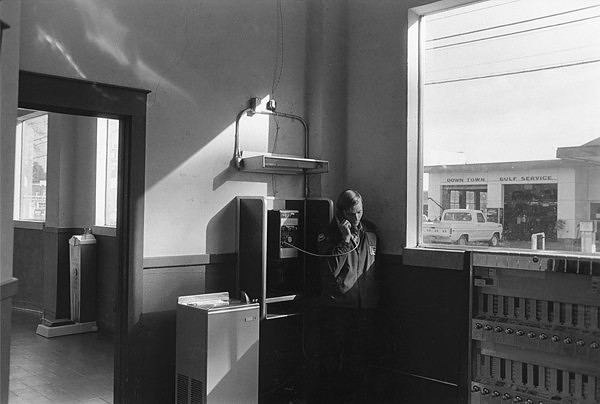
"Trailways Bus Station" (1978) by Paul Kwilecki Paul Kwilecki was a hardware store owner and member of the Rotary Club when he first picked up a camera in 1959 and began taking pictures of daily life in his native Bainbridge, Georgia and surrounding county. He kept at it for the next 50 years, becoming one of America’s most eminent documentary photographers. He turned his camera on the courthouse, the bus station, cemeteries, high school proms, black Pentecostal churches and people at work in factories and shade tobacco fields. Kwilecki acknowledged there was nothing special about Decatur County. His true subject was the human condition, and he figured people were essentially the same everywhere. There were also advantages to growing up in the place you were photographing. “If you stay in one place,” he wrote, “instead of skidding across the surface of the material, you penetrate down into it, where the rich deposits are.” Kwilecki learned to take nothing for granted. He said, "If I could teach myself to take what I saw literally, dust off the sediment of overfamiliarity, and then carefully examine what is exposed underneath, I would have more raw material than I know what to do with.” Far from becoming dulled by familiarity, Kwilecki found, “the further I go the more mysterious the place becomes.” As a photographer myself, I am acutely aware of the danger of overfamiliarity, because it prevents you from seeing what is before your own eyes. Just yesterday, I was going through my usual early-morning routine of opening curtains downstairs, when I stopped myself. It was as if I had suddenly awakened halfway through, discovering some of the curtains open and realizing I must have been the one who opened them. My mind had been elsewhere. Most of us do this to a greater or lesser extent all day long. We rely on habit to get us through our rounds, which allows us to turn our attention to anything but what we are seeing and doing right now. Kwilecki was careful to distinguish between dynamic reality and what is captured in a static frame of film. However, I have found that putting a frame around reality forces a serious photographer to pay close attention to what he actually sees, to the particular qualities of the persons or places being photographed. You must be concerned about composition, form, color, texture and, above all, light – not as abstractions but in their particularity as you try to capture a subject. Once you have mastered the basics of your craft, you aren’t thinking about any of these things. You are working on instinct in hopes of taking a picture that pleases the eye. A photograph is an artifact, not reality, but if the image is any good, it will have made you see. Seeing and knowing are not the same thing. To know a place is to place it in memory; to associate it with other times and other places; to compare and contrast; above all, to put words to it. The world we know is a giant jigsaw puzzle with all the pieces carefully labeled. To see the world as a great photographer would is to see it with the eyes of a newborn, with all the labels removed. And here something magical happens. Even though you put a frame around it, the jigsaw pieces disappear, and you see the place whole. This gets at the mysteriousness that Kwilecki alluded to. You can capture the essense of a place that is in every respect utterly unfathomable. The Bell Tolls for Thee
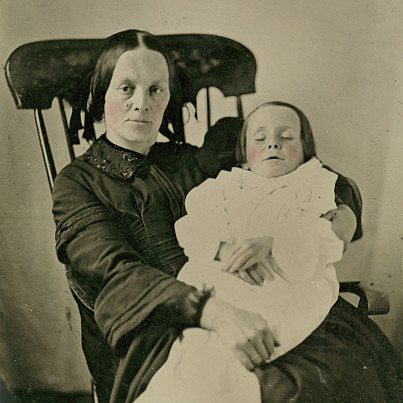
In the early decades of photography, exposure times were so long it was easier to take pictures of the dead rather than the living, since the subjects didn’t move. People sitting for a portrait were sometimes fitted with a neck brace to help them keep still, which is why they often looked like rigor mortis had set in, even when they were alive. As it happened, many were not. Until the late 19th century, post-mortem photographs were a popular way to memorialize the recently deceased, particularly infants and small children. Many commercial photographers specialized in them at a time when photography was expensive and family portraits of any kind were still rare. Photographers often went to great lengths to capture life-like poses of the dead: infants ostensibly asleep in their cribs, children cradled in their mothers’ arms, adults propped up in bed or even sitting in chairs. Memorial photographs were often hand-tinted to put a rosy bloom on pallid cheeks or were otherwise retouched so that eyes closed in death might look open. For obvious reasons, the dead often appeared more relaxed in photographs than their living counterparts. Modern sensibilities recoil from the seemingly morbid preoccupations of our Victorian ancestors. And yet it’s not at all clear that doing away with such graphic reminders of our own mortality is necessarily an improvement. In an influential essay entitled “The Pornography of Death,” British sociologist Geoffrey Gorer argued that we have merely replaced the Victorian squeamishness about sex with a modern-day taboo against death. Political considerations aside, the Bush Administration’s ban on photographs of flag-draped coffins coming out of Iraq is indicative. Contrast this with the corpse-strewn battlefields immortalized in Matthew Brady’s photographs of the Civil War, where a single battle could kill more soldiers in a day than all those lost in some of our recent wars. Death may be no less a fact of life than sex, but nowadays we’d prefer the evidence be kept well out of sight. |