Close to Home
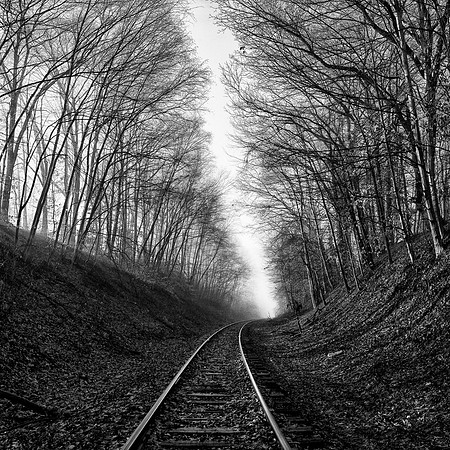
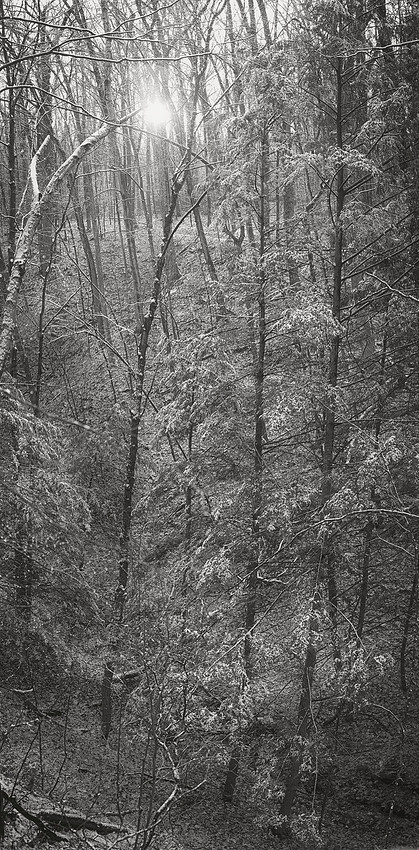
There are obvious advantages to shooting close to home. You know the territory, and you don't have to travel long distances, only to discover that a change in weather, lighting or a thousand and one other circumstances have defeated your purpose. (My brother-in-law, a long-range weather forecaster of the National Oceanographic and Atmospheric Admintration, once traveled to Hawaii to view a solar eclipse but never saw it due to dense cloud cover.) I suppose I should be envious of photographers who venture far afield to shoot exotic locales. But after a long business career that often involved getting on airplanes and flying hither and yon, I am content these days to stick close to home. The challenge for me is to find beauty and mystery in things that lie close at hand. More Trees
Too Beautiful
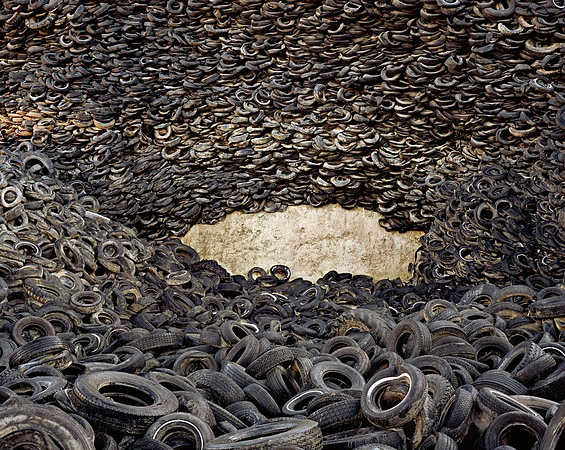
"Dead Tire Graveyard" by Edward Burtynsky
Art is collaboration between God and the artist, A photographer friend of mine had a show in New York more than 40 years ago, a series of exquisite landscapes taken in Ireland. I no longer remember whether it was a solo show or was put on in conjunction with a display of documentary photographs on the then current “troubles” in Northern Ireland. I just remember that the two series were reviewed side by side, and my friend’s luminous images were made to seem trivial when contrasted with a portrayal of the sectarian bloodshed just across the border in Ulster. It was as if Turner’s seascapes should be dismissed because they did not grapple with the grisly subject matter in Goya’s The Disasters of War. The unspoken assumption was that my friend’s work was unworthy of serious consideration because it was too beautiful. As a landscape photographer myself, I have encountered this attitude more times than I care to recall. I find myself hesitating to submit certain photographs to juried competitions if they might be considered too aesthetically pleasing. I’m not talking here about pretty pictures as such. The challenge for a serious landscape photographer is always to find beauty beyond the commonplace. Nor is beauty merely a question of photographing a pristine landscape in a certain light. As Edward Burtynsky has demonstrated, it is possible to find surpassing beauty in an open-pit mine, in mountains of discarded rubber tires and in a ship-breaking graveyard. The subject of a photograph need not be beautiful at all, as such things are reckoned. But neither should it be discounted if it finds beauty in its subject. In a recent article on current trends in photography, Quentin Bajac, the chief curator of photography at the Museum of Modern Art in New York, said, “The biggest problem facing curators and historians of photography is the overflow of images.” There is, to begin with, a monstrous glut of images used in advertising, to say nothing of the billions of images captured on cell phones. Even high-end cameras – which are essentially computers with a viewfinder and lens – enable ordinary folk to take technically competent photographs without the expense and bother of film or darkrooms. These images are digitized and easily manipulated on a computer, allowing Photoshop to cover a multitude of sins. It would seem there are few remaining barriers to entry for an artistic undertaking, much less any clearly demarcated aesthetic standards to worry about. Photography, of course, had long labored in the shadow of the other graphic media, and its hard-won legitimacy has come at a time when some would say the visual arts in general have lost their way. To cite one small example, no sooner had authorities finally succeeded in scrubbing the graffiti from subway cars in New York City than it found its way into SoHo galleries and museum walls. We are undeniably a long way from a time when art was regarded as "an imitation of Nature in Her manner of operation," in the words of the 13th-century Roman Catholic theologian Thomas Aquinas. Artists no longer labor anonymously within traditional forms to produce work that declares the glory of God. Art has become an end in itself, and it declares nothing so much as the glory of the artist. Everything is on the surface, yielding its substance at a glance. Strip away the ceaseless quest for novelty, the posturing, the empty striving for effect, and there is little left but a sense of impoverishment. I came to photography relatively late in life and missed out on some of the normal formative stages of artistic development. I did not imitate work that I admired or get caught up in the latest trends. I was not interested in launching a career. I was interested only in learning the technical aspects of my craft so I could take pictures that expressed something of the world as I saw it. I try to take pictures the way a newborn would, assuming that a newborn came into the world knowing how to work a camera. A newborn does not think he has seen it all before and so pays attention to everything. A newborn is anonymous in the literal sense of the term, which means “without a name.” You have no sense of self, much less a sense of oneself as an artist, and so you are free to see the world around you as God must see it and then to declare its glory. Mirror World
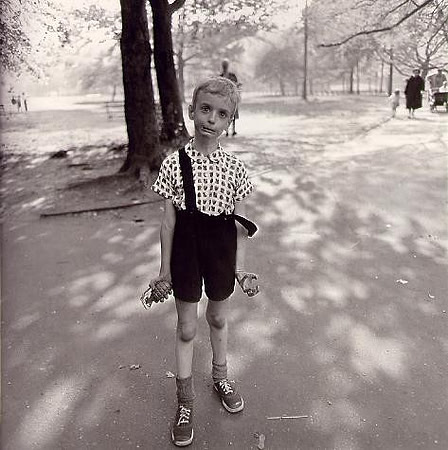
As a photographer, I have had occasion to reflect on the limits of objectivity. Of all the art forms, photography supposedly comes closest to presenting an objective view of its subject. After all, the camera is a mechanical device that captures whatever patterns of light and shadow happen to pass through its lens onto a strip of film or onto a digital sensor. Yet from its inception, photography has proven to be an ideal medium for presenting subjectivity as objectivity. Never mind the overt manipulations that take place in the darkroom or with the artful interventions of Photoshop. The mere act of taking a photograph alters reality by putting a frame around it. As Susan Sontag noted in her book On Photography, “There is no way to suppress the tendency inherent in all photographs to accord value on their subjects.” For the subjects, if they happen to be self-conscious beings, having their picture taken is almost always an out-of-body experience. A photographer points a camera at you, and you can’t help imagining yourself inside a picture frame. Your facial expression and body language adjust accordingly. I find this to be true even when I take a picture of myself, try as I might to look natural. How do I look natural without imagining myself as I might appear to others in the photograph? Inevitably, the subject of a photograph is the photographer, regardless of where he or she is pointing the camera. This can be seen readily in the work of Diane Arbus, who is most closely associated with photographs of circus freaks, nudists, transvestites and other exotic classes of humanity. It is not immediately clear why Arbus was drawn to the margins of society, since she came from a privileged background and did not appear at all freakish herself. Yet her pictures all had a certain strangeness about them, even if the ostensible subject matter was as ordinary as a child playing in a park. A case in point was a black-and-white photograph entitled “Child with Toy Hand Grenade in Central Park” (1962) above. A skinny boy of perhaps seven or eight wearing shorts and sneakers stands facing the camera, his arms held rigidly at his sides. He clutches a plastic hand grenade in one hand and the other is curled up like a bird’s claw. His head is tilted, and he is staring, with a strange grimace on his face. Seen in isolation, you might imagine that the subject of the photograph was demented or suffering from an advanced neurological disease. However, if you view the contact sheets from this photo session, you will see a perfectly ordinary child playing in the park. As a tireless photographer of a granddaughter about the same age, I can tell you it can be a challenge to take a picture when the subject is not making a face. The difference between Diane Arbus and me is that I edit out the images where my granddaughter is clowning for the camera. I am interested in presenting my granddaughter as she appears when she is not aware that I am taking a picture, whereas Arbus is after something different. The quality of strangeness captured in the fleeting image of the little boy grimacing for the camera is what makes the image a Diane Arbus. From there it is a small step to eliminate the indefinite article and say the image is Diane Arbus. Light
No serious photographer takes light for granted; it is his or her stock in trade. The very term photography means “writing with light.” Admittedly, cameras are now so computerized you can ignore the built-in light meter and allow the exposure to adjust automatically. I do this sometimes when I need to work quickly. But if I really want to set up a shot and do some fine-tuning, I must start with the light. Which, interestingly enough, is how God did it when he created the world. “Let there be light,” he commanded when he kicked things off in the Book of Genesis. Of course, with God there was no light until he called it into being. For the photographer, the light is already there; it is the medium in which he works his art. But how did it get there? Leaving aside the Genesis account for a moment, cosmologists currently believe the universe began in a blaze of light called the Big Bang. They know this because the afterglow from this cosmic event is still detectable nearly 15 billion years later as background microwave radiation that pervades the universe. It must have been one hell of a bang. But it went undetected at the time because there was no one to witness it. This raises a philosophical issue simlar to the problem of a tree falling in a forest when there is no one to hear. Does light exist if there is no one to see? Perhaps the question we should be asking is not where light came from but where seeing came from. The universe existed in utter darkness for billions of years, even if it was abaze with galaxies and stars, simply because no sentient being was able to perceive the light. Then rudimentary “eyespots” made up of photoreceptor proteins began showing up in even in the simplest organisms on earth. Complex optical organs emerged during a period of rapid biological diversification called the “Cambrian explosion” some 540 million years ago. In his famous “argument from design” in the early in the 19th century, the naturalist and Anglican cleric William Paley singled out the human eye as evidence of a creator’s handiwork in the formation of the universe. Charles Darwin recognized that his theory of evolution “would absolutely break down” if it could not account for the development of an organ as complex as the eye. Proponents of intelligent design continue to argue that the “irreducible complexity” of the human eye could not have been produced by the blind processes of natural selection alone. As it happens, naturalists maintain that the eye has evolved not once but many times in a process called convergent evolution. Convergence in evolution is the independent development of similar biological features in unrelated species. A case in point is the nearly identical eye in humans and squids, which have followed separate evolutionary paths for more than 700 million years. Their respective camera-like eyes work very much like my high-end Canon digital SLR, although fully automated and with much greater light sensitivity. Overall, according to evolutionary biologist Richard Dawkins, the eye has developed independently dozens of times using nine separate basic designs. “It seems that life, at least as we know it on this planet, is almost indecently eager to evolve eyes,” Dawkins has written. Notwithstanding the suggestion of an underlying purpose here, neither Dawkins nor any other orthodox Darwinist believes there is anything intentional about it. Teleology – the idea that nature acts purposefully -- is still a dirty word in most scientific circles. The title of Dawkins’ book, The Blind Watchmaker, sums up mainstream thinking on how evolution works. The human eye and every other organ and biological process in nature developed by painstaking trial and error, with no blueprint and no overarching principle other than natural selection based on adaptation to the environment. However, cracks have begun to appear in the heretofore-unbroken surface of evolutionary thinking. Paleontologist Conway Morris, whose study of fossils in the Burgess Shale led to the concept of the Cambrian explosion, has suggested convergence may point to a “deeper structure to biology” – deeper than purely random genetic mutations in unrelated species that somehow result in nearly identical eyes that are better engineered than my Canon digital SLR. As Dawkins himself demonstrated in his remark about the indecent eagerness of life to evolve eyes, there is a tendency for even the staunchest Darwinist to lapse into teleological metaphors when talking about nature. If you didn’t know any better, you might think that God, having commanded the light to shine, then set about through painstaking trial and error to bring into the world creatures who were capable of watching the show. |