Too Beautiful
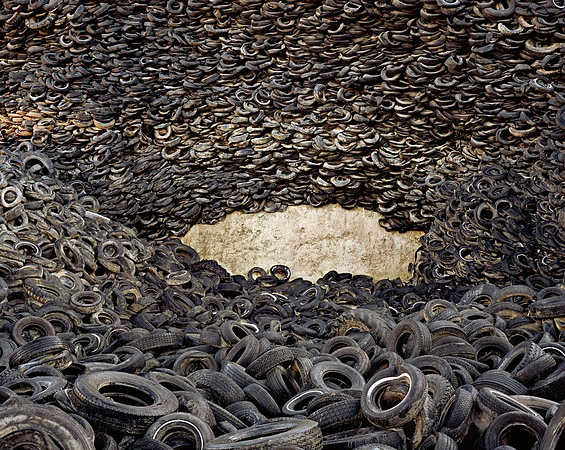
"Dead Tire Graveyard" by Edward Burtynsky
Art is collaboration between God and the artist, A photographer friend of mine had a show in New York more than 40 years ago, a series of exquisite landscapes taken in Ireland. I no longer remember whether it was a solo show or was put on in conjunction with a display of documentary photographs on the then current “troubles” in Northern Ireland. I just remember that the two series were reviewed side by side, and my friend’s luminous images were made to seem trivial when contrasted with a portrayal of the sectarian bloodshed just across the border in Ulster. It was as if Turner’s seascapes should be dismissed because they did not grapple with the grisly subject matter in Goya’s The Disasters of War. The unspoken assumption was that my friend’s work was unworthy of serious consideration because it was too beautiful. As a landscape photographer myself, I have encountered this attitude more times than I care to recall. I find myself hesitating to submit certain photographs to juried competitions if they might be considered too aesthetically pleasing. I’m not talking here about pretty pictures as such. The challenge for a serious landscape photographer is always to find beauty beyond the commonplace. Nor is beauty merely a question of photographing a pristine landscape in a certain light. As Edward Burtynsky has demonstrated, it is possible to find surpassing beauty in an open-pit mine, in mountains of discarded rubber tires and in a ship-breaking graveyard. The subject of a photograph need not be beautiful at all, as such things are reckoned. But neither should it be discounted if it finds beauty in its subject. In a recent article on current trends in photography, Quentin Bajac, the chief curator of photography at the Museum of Modern Art in New York, said, “The biggest problem facing curators and historians of photography is the overflow of images.” There is, to begin with, a monstrous glut of images used in advertising, to say nothing of the billions of images captured on cell phones. Even high-end cameras – which are essentially computers with a viewfinder and lens – enable ordinary folk to take technically competent photographs without the expense and bother of film or darkrooms. These images are digitized and easily manipulated on a computer, allowing Photoshop to cover a multitude of sins. It would seem there are few remaining barriers to entry for an artistic undertaking, much less any clearly demarcated aesthetic standards to worry about. Photography, of course, had long labored in the shadow of the other graphic media, and its hard-won legitimacy has come at a time when some would say the visual arts in general have lost their way. To cite one small example, no sooner had authorities finally succeeded in scrubbing the graffiti from subway cars in New York City than it found its way into SoHo galleries and museum walls. We are undeniably a long way from a time when art was regarded as "an imitation of Nature in Her manner of operation," in the words of the 13th-century Roman Catholic theologian Thomas Aquinas. Artists no longer labor anonymously within traditional forms to produce work that declares the glory of God. Art has become an end in itself, and it declares nothing so much as the glory of the artist. Everything is on the surface, yielding its substance at a glance. Strip away the ceaseless quest for novelty, the posturing, the empty striving for effect, and there is little left but a sense of impoverishment. I came to photography relatively late in life and missed out on some of the normal formative stages of artistic development. I did not imitate work that I admired or get caught up in the latest trends. I was not interested in launching a career. I was interested only in learning the technical aspects of my craft so I could take pictures that expressed something of the world as I saw it. I try to take pictures the way a newborn would, assuming that a newborn came into the world knowing how to work a camera. A newborn does not think he has seen it all before and so pays attention to everything. A newborn is anonymous in the literal sense of the term, which means “without a name.” You have no sense of self, much less a sense of oneself as an artist, and so you are free to see the world around you as God must see it and then to declare its glory. |
Archive
January
February
March
April
May
June
July
August
September
October
November
December
|