A Sense of Place
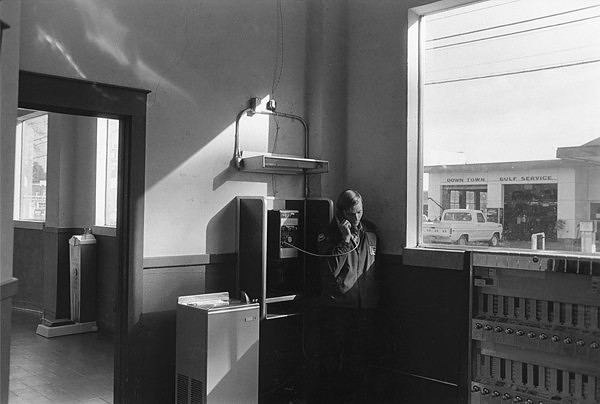
"Trailways Bus Station" (1978) by Paul Kwilecki Paul Kwilecki was a hardware store owner and member of the Rotary Club when he first picked up a camera in 1959 and began taking pictures of daily life in his native Bainbridge, Georgia and surrounding county. He kept at it for the next 50 years, becoming one of America’s most eminent documentary photographers. He turned his camera on the courthouse, the bus station, cemeteries, high school proms, black Pentecostal churches and people at work in factories and shade tobacco fields. Kwilecki acknowledged there was nothing special about Decatur County. His true subject was the human condition, and he figured people were essentially the same everywhere. There were also advantages to growing up in the place you were photographing. “If you stay in one place,” he wrote, “instead of skidding across the surface of the material, you penetrate down into it, where the rich deposits are.” Kwilecki learned to take nothing for granted. He said, "If I could teach myself to take what I saw literally, dust off the sediment of overfamiliarity, and then carefully examine what is exposed underneath, I would have more raw material than I know what to do with.” Far from becoming dulled by familiarity, Kwilecki found, “the further I go the more mysterious the place becomes.” As a photographer myself, I am acutely aware of the danger of overfamiliarity, because it prevents you from seeing what is before your own eyes. Just yesterday, I was going through my usual early-morning routine of opening curtains downstairs, when I stopped myself. It was as if I had suddenly awakened halfway through, discovering some of the curtains open and realizing I must have been the one who opened them. My mind had been elsewhere. Most of us do this to a greater or lesser extent all day long. We rely on habit to get us through our rounds, which allows us to turn our attention to anything but what we are seeing and doing right now. Kwilecki was careful to distinguish between dynamic reality and what is captured in a static frame of film. However, I have found that putting a frame around reality forces a serious photographer to pay close attention to what he actually sees, to the particular qualities of the persons or places being photographed. You must be concerned about composition, form, color, texture and, above all, light – not as abstractions but in their particularity as you try to capture a subject. Once you have mastered the basics of your craft, you aren’t thinking about any of these things. You are working on instinct in hopes of taking a picture that pleases the eye. A photograph is an artifact, not reality, but if the image is any good, it will have made you see. Seeing and knowing are not the same thing. To know a place is to place it in memory; to associate it with other times and other places; to compare and contrast; above all, to put words to it. The world we know is a giant jigsaw puzzle with all the pieces carefully labeled. To see the world as a great photographer would is to see it with the eyes of a newborn, with all the labels removed. And here something magical happens. Even though you put a frame around it, the jigsaw pieces disappear, and you see the place whole. This gets at the mysteriousness that Kwilecki alluded to. You can capture the essense of a place that is in every respect utterly unfathomable.
Keywords:
Paul Kwilecki,
documenary photography
|
Archive
January
February
March
April
May
June
July
August
September
October
November
December
|