Black & White Exhibit
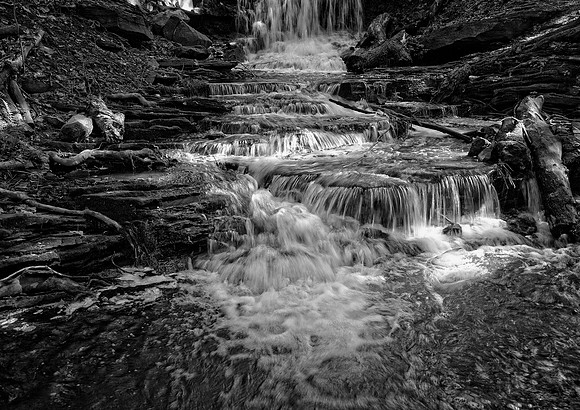
Cascade by Eric Rennie The image above is one of 72 selected (out of 1220 submissions) for an exhibition of black & white photographs at the Minneapolis Photo Center running from September 12 to November 4, 2014. The juror for the competition is photographer Paul Berlanga, who is also director of the Stephen Daiter Gallery in Chicago. The photo was taken at Dividend Pond in Rocky Hill, CT, site of an old colonial gristmill. Three different exposures were blended in this picture because of the patchwork of bright sunlight and shadow and the rapidly moving water. Spirit Photography
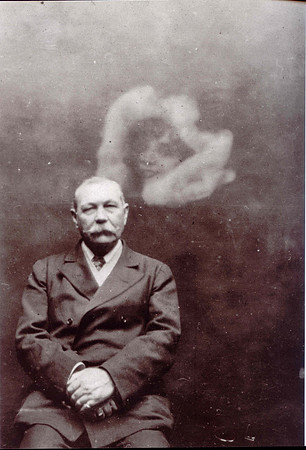
Sir Arthur Conan Doyle with Spirit (1922), Photograph by Ada Emma Deane The medium of photography arose at about the same time as mediums of a different sort -- the kind that claimed contact with the spirit world -- so it is not surprising that the two should intersect. Spiritualism enjoyed a certain vogue starting in the mid-19th century, and it was not long before unscrupulous photographers began to capitalize on it. Ghostly images were easy to produce, since exposure times were so long with early cameras that any movement by the subject would leave a blurred, transparent after-image on the photographic plates. Photographers used a variety of tricks to superimpose spectral images onto portraits of live subjects. A pioneering spirit photographer named William H. Mumler created a minor sensation by producing a portrait of Mary Todd Lincoln with a gauzy likeness of her dead husband standing behind her. Sir Arthur Conan Doyle, who proved much more credulous than his fictional hero, Sherlock Holmes, posed for the portrait above, taken by a leading spirit photographer of the day, Ada Emma Deane. Doyle, a stout defender of spiritualism, had lost two sons in the 1918 influenza epidemic and a brother-in-law in World War I and was desperate to make contact with them in the spirit world.
Canonical Hours
To men alone time is elusive; to men with God time is eternity in disguise. I was up before sunrise to take pictures from a bluff overlooking the Connecticut River not far from my house. I brought a camera and tripod to take a long-exposure panoramic shot of the river just as the sun was coming up over a fringe of trees on the opposite shore. Tramping through the woods on the way back home, I found myself humming “Frère Jacques,” a song I had not sung or even thought about since French class in junior high school. The same few lines played over and over in my head:
Sonnez les matines, sonnez les matines, I learned long ago that obsessive refrains like this were sometimes my mind’s way of signaling a message from my unconscious. So what was I trying to tell myself? The song refers to church bells that are rung to summon the faithful to morning prayers. Frère Jacques, or Brother John, the monk charged with ringing the bells, has apparently overslept. I realized as I made my way back home that it was about seven a.m., the traditional hour for morning prayers, or matins, in the daily cycle of prayers practiced by clerical and monastic orders since antiquity. The song I had been humming was a wake-up call, and I was Frère Jacques. Western religions have long sought to sanctify time by setting aside specified periods for prayer. This began with the Jewish Sabbath on the seventh day of each week to observe the day on which the Lord rested from his labors in creating the world. Priests in the Temple were also commanded to make ritual sacrifices each morning and evening, which evolved into offering prayers at set times every day. These practices were incorporated into the early life of the Christian church and later developed by the monastic orders into an elaborate round of daily prayers known as the canonical hours. For many centuries the call to prayer has been rung eight times throughout the day and at wider intervals during the night. The bells are a reminder that life unfolds within a framework that Rabbi Abraham Joshua Heschel refers to as “the architecture of time.” In the biblical creation story, time begins when God summons light from darkness, calling them day and night and setting them in motion. A landscape photographer must always be attuned to the play of light and darkness in the natural world, since that is his subject. His world is not cloistered, and there are usually no bells to summon him to prayer. But at its best, his work becomes a form of prayer. In sanctifying our hours and days, by whatever means, we are anchoring time in the still wider framework of eternity. Eternity is not timelessness but rather the still space in which time is contained, along with everything that transpires in time. The canonical hours are an invitation to plant oneself in this wider space, to be reminded that we are in the world but not of it. Eternity is not grasped in the passage of time but in a single moment that opens before us like a revelation. There is no longer past or future, but only right now, and the realization that “right now” is all there is. Nothing You Can See that Isn't Shown
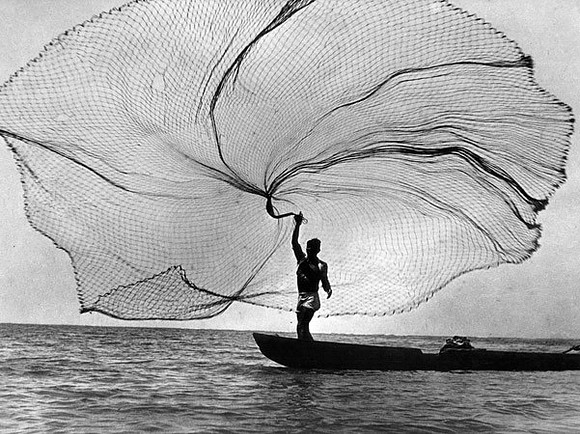
Photograph by Henri Cartier-Bresson
I did not take up photography as a spiritual exercise, but that is what it became once I realized that the aims of photography and of meditative practice are essentially the same. Buddhists call it “clear seeing” – learning to perceive what is actually there rather than what we think is there. We think we see the world as it is, but the philosopher Owen Barfield has noted “the perceptual world comes over its horizon already organized.” The mind seeks to make sense of its environment by applying concepts, attitudes and judgments to raw sensory experience, including such fundamental concepts as time and space. These reflexive mental processes are no doubt essential to our ability to navigate the world. But we inevitably fall back on habitual modes of thought and feeling rather than experiencing life as it actually is at this moment.
A curious thing can happen when the world is seen – really seen -- through the lens of a camera. The larger world of context falls away, and we are confronted by pure color, form, texture, light and shadow. There is no subject as such, at least none that we can put words to at this moment. “To see is to forget the name of the thing one sees,” the poet Paul Valéry said. Once we put words to it, we are in the realm of thinking, not seeing. There is no calculation in the realm of unadulterated seeing. We do not click the shutter because we think what we see in the viewfinder will make a good picture. We are more like the Zen archer who releases his arrow at just the right moment without aiming. The picture takes itself.
The photographer Henri Cartier-Bresson talked about the “decisive moment” when color, form, texture, light and shadow come together just so. "Photography is not like painting," he told a Washington Post writer. "There is a creative fraction of a second when you are taking a picture. Your eye must see a composition or an expression that life itself offers you, and you must know with intuition when to click the camera.” Having begun as a painter himself, Cartier-Bresson compared photography to a quick sketch “done with intuition, and you can’t correct it. If you have to correct it, it’s the next picture. Life is very fluid. Life is once, forever.”
Cartier-Bresson, a photojournalist and street photographer, began taking pictures in the 1930s using a Leica with a 50mm lens, which allowed him much greater spontaneity than earlier box cameras. To capture life on the fly, he said, you had to be like an animal with its prey. As a landscape photographer working with a digital camera and tripod, I don’t need to be nearly as quick about it. I can afford to lie in wait for the moment, but it always comes down to the moment: the sun coming up over the horizon, the fog burning away in the summer heat, the clouds moving across the sky, reflections dancing on the water, the continuous play of light and shadow. This is what life itself offers me in the moment. “You can’t look for inspiration,” Cartier-Bresson insisted, which may sound confusing, since he was always looking. Here he was making a distinction between seeking and seeing. To look for something is to seek it, as opposed to recognizing it when you see it. The initiative here is not with us but with whatever it is that chooses to reveal itself to us in the decisive moment. All we have to do is to pay attention. Face of Evil
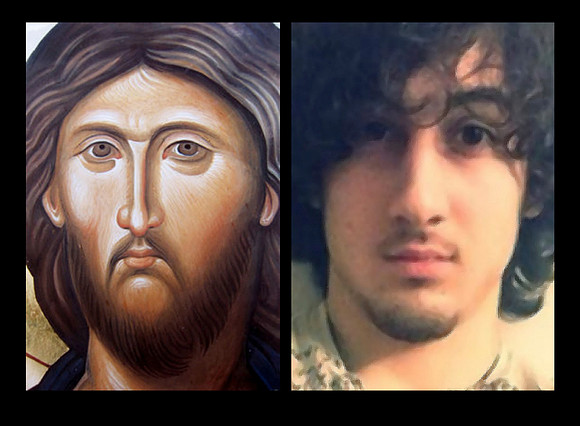
George Orwell once said at age 50 everyone has the face he deserves. Underlying this remark is the assumption that a human face reveals something of a person's character -- an assumption also implicit in portrait photography. If a person is evil, for example, can you tell just by looking at him? Is there a true face of evil? Surely not the face of Christ, above left, that graced the cover of the Sunday bulletin at the church service I attended a year or so ago. The image was a contemporary icon in the Byzantine tradition by British artist Aiden Hart. Although I had never seen it before, the icon appeared hauntingly familiar. I realized why when I got home and saw almost the same face staring back at me, above right, on the front page of the Sunday New York Times. There was the same long dark hair, the same large almond eyes, straight nose, rosebud mouth and whispy beard. The icon on the church bulletin bore an uncanny resemblance to Dzokhar Tsarnaev, the accused Boston Marathon bomber – enough like him to be his older brother; indeed, more like him in appearance than Tsarnaev’s real older brother, who was gunned down in a firefight with police several days after the Boston Marathon bombings.
My point here is not that Christ is a terrorist but that his dark Mediterranean features conform to the stereotype of the terrorist implanted in the collective psyche of Americans traumatized by the 9/11 attacks and all that has come after. If anything, the icon appeared more sinister than the young Tsarnaev, who looked more like a poet than someone capable of killing and maiming scores of innocent people. What is truly disturbing about evil is that it has no face – or at least none that is readily identifiable as such. In that respect, it is just like us. Of all the faces in the world, the one face we cannot see – at least not directly – is our own. We may see its reflection everywhere, but if, like Narcissus, we mistake the reflection for something else, we are on a fool’s errand. So it is with evil. We must not look outside ourselves but look within. As the old radio series put it: Who knows what evil lurks in the hearts of men? The Shadow knows!
|