Windows and Doors
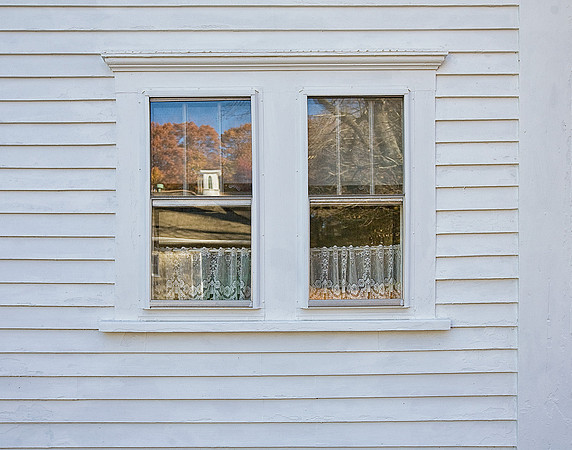
The photo above is part of an online exhbition opening November 15, 2014 at the 1650 Gallery in Los Angeles in connection with a juried competition called Windows and Doors. The photo was taken several years ago at the little farmhouse in Blackstone, Massachusetts where my father grew up during the Depression and where my Aunt Mildred was still living until she was past 100. All that remained of my grandfather's dairy farm, which had been in the family since 1910, were a few outbuildings, including the barn you see reflected in the lace curtain window. The I Is Not an Object
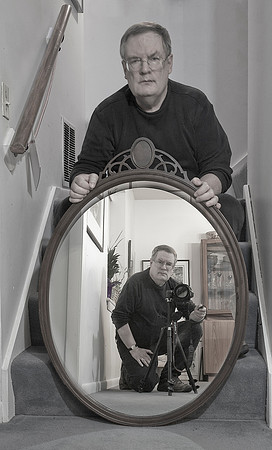
“The I is not an object,” the philosopher Ludwig Wittgenstein once wrote. As it happens, Wittgenstein was a photography buff, although I don’t think that really figured in his ruminations on the self. For a photographer, self-portraits present some unique technical hurdles, since you can’t actually see what you shooting. You can photograph your image in a mirror, which will give you the mirror-reverse of how you look to everyone else. Or you can mount your camera on a tripod, and set the timer and automatic focus. Either way, you are reminded that the face that is most familiar to you is the one you can never see directly. Philosophers are faced with a similar problem in trying to understand the self. Sometimes we think of the self as the subject and sometimes as the object of our awareness, which the 19th-century German philosopher Arthur Schopenhauer regarded as “the most monstrous contradiction ever thought of.” It puts us in the awkward position of a photographer trying to peer at himself in the viewfinder of his camera. Or as Wittgenstein put it, “I objectively confront every object. But not the I.” I tried to illustrate this conundrum with the self-portrait above of me holding a large oval mirror in which you could see a reflection of me crouched beside a camera on a tripod photographing me holding the mirror. In reality, of course, there were two images of myself layered into a single photograph using Photoshop and various add-ons. Neither image depicted the self as subject, the “I” that observes everything but leaves no trace of itself in the world as the object of its own awareness. With Photoshop, I can place myself on both sides of the camera, but there can’t actually be two of us – so how do I resolve Schopenhauer’s “monstrous contradiction”? The subjective self – the one that peers through the viewfinder of the camera – is essentially invisible. As the designated photographer at many family events, I am apparently never present at the festivities because I am never in any of my own pictures. My other self – the one that is the object of my awareness – is anything but invisible. It has its strengths and weaknesses, its likes and dislikes, a sense of humor, a personality with some quirks thrown in. I might even be tempted to say it is the ground of my being--except that it is not. I am grounded in my awareness of the world, which is my subjective self. So if I must choose between two selves, that is the real me. The self that is the object of my awareness may be anything but invisible but it is still an illusion. The Dark Side
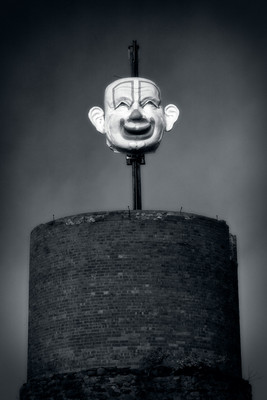
Just in time for Halloween, the photograph above is appearing in juried competitions on opposite coasts: in an exhibition called "The Dark Side" at the 1650 Gallery in Los Angeles and at a show called "Midnight Eerie" at Gallery 136-1/2 in Manchester, CT. The Los Angeles show, which is curated by gallery owner Andrew Overtoom, opens October 11 and features 60 images. The Connecticut exhibit, which was curated by Jessica Somers and features work by 27 photographers, runs from October 25-November 25. Of note to connoisseurs of a certain age: the clown head is purportedly modeled after Clarabell the Clown, Buffalo Bob's sidekick on The Howdy Doody Show, which ran on NBC from 1947 until 1960. Clarabell was played by Bob Keeshan, who went on to greater glory as Captain Kangaroo on the kiddie show of the same name. The 600 lb. clown head is mounted on a motorized track that runs up and down atop a 33-foot brick silo next to Wild Bill's Nostalgia Emporium in Middlertown, CT. The overall effect is pretty creepy. I can only imagine what might happen if archeologists of a future epoch unearthed this artifact. They might assume our civilization worshipped a clown god. Another of my photographs, entitled Trolley Museum at Night, is also appearing in the 1650 Gallery show. Framed
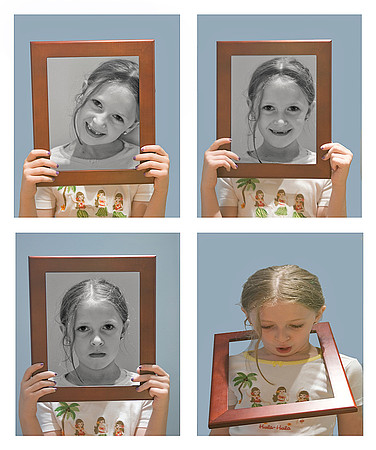
“To photograph is to frame,” Susan Sontag once wrote, “and to frame is to exclude.” Documentary filmmaker Errol Morris made a similar point when he said, “You can never see the absence of something in a photograph….A photograph decontextulizes everything. You see this swatch of reality that has been torn out of the fabric of the world.” Sontag and Morris were each discussing photography in its portrayal of war and violence. Sontag complained that photography contributed to a “culture of spectatorship” by enabling viewers to take in the horrors of war at a safe distance, outside its original context. She noted that Roger Fenton – generally regarded as the first war photographer – was dispatched to the Crimea in 1855 by the British government with instructions not to take pictures of the dead or wounded. Since every photograph involves decisions as to how to frame the shot, when to release the shutter and how to crop the print, Morris has argued that all are essentially “posed.”
Photojournalists clearly have some obligation not to distort the truth by what they choose to include or exclude in their work. But it may be stretching the point to suggest that all photography is posed. The underlying assumption is that reality is unbounded and that we necessarily falsify it by putting a frame around it. Granted, a photographer must make many aesthetic and technical choices about what goes inside the frame, starting with where to point the camera. But, in my experience, these choices are driven by a desire to reproduce as faithfully as possible what the photographer seeks to portray.
It’s not as if reality as we perceive it exists in some pristine state that is somehow compromised by the artifice of photography. Nature already comes to us fully framed by fundamental concepts of time and space that are learned, not innate. The world that greets the newborn is timeless, formless, meaningless – a “great blooming, buzzing confusion,” as the psychologist William James once characterized it. Only gradually do children learn to separate the thoughts and feelings “inside” themselves from the physical attributes of the realm “outside” themselves – in effect, putting a frame around the world.
I once had a photography teacher who insisted that we not crop our images. By this time I had already spent many years in corporate communications, where pictures were routinely cropped to fit layouts. When you think about it, there is no reason to expect that a particular subject you are shooting will automatically fit the frame of your lens. Nevertheless, I followed instructions and found the no-cropping rule helpful in composing the image I was trying to capture. Your tendency is to focus on the center of the image, but you also need to pay attention to what appears in the corners.
A photographer knows better than anyone that a photograph is an artifact that must be considered on its own terms, rather than as a representation of reality. It is a product of the photographer’s collaboration with the world, not something torn from its fabric. There are certainly times when it is appropriate to ask what may lie outside the frame. But the frame’s purpose is not primarily to exclude; it is to call attention to what lies within. The world unframed by any thought, much less by a camera, is essentially without form and void. Put a frame around it and you may yet wind up with a work of art. Singleness of Eye
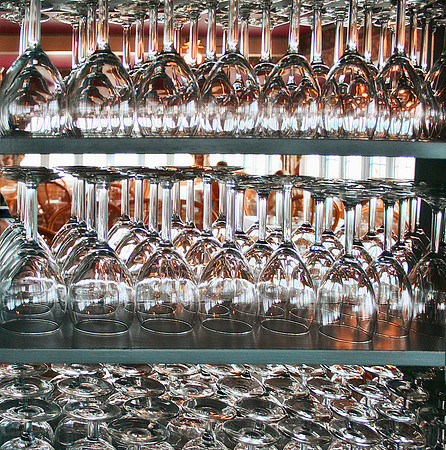
Glassware by Eric Rennie I took a course my freshman year in college in which we learned how to see. I didn't realize that's what I would be taking when I signed up for it. I thought I would be taking a drawing course, and that's what we did. But the instructor understood that to draw properly we had to learn how to see. That proved to be more difficult than you would think, since by that time we had all fallen into the habit of looking without really seeing. So we filled our sketchpads with straight lines, curved lines, parallel lines, lines of varying thickness. We drew chairs, tree branches, our own hand. Gradually, over the course of the term, we were forced to see the world afresh, never taking our eye off an object as our hand painstakingly traced its contours on the page. One way to understand Jesus of Nazareth is that he came to teach the world how to see. If thine eye be single, he said, thy whole body shall be full of light. "Single" is sometimes translated as "clear" or "good," but the literal meaning of the original Greek is "without folds." To see the world as it is, without folds, you need to see with a single eye. This means you need to be able to see the world without naming it. Language turns everything into a gigantic jigsaw puzzle, with all the pieces carefully labeled. Even if we reassemble the pieces into a coherent picture, it's not the underlying unity we see but a pattern of puzzle pieces.
"Swifter than light the world converts itself into that thing you name," Emerson wrote in his journal, "and all things find their right place under this new and capricious system." Our most basic concepts about the world -- of time and space, self and other -- are learned at our mother's knee. These are not phenomena of nature but constructs of the mind. To see the world whole again, rather than as merely the sum of its parts, we have to see it with the eyes of a newborn. This is what Jesus was getting at when he said one must be born anew to see the kingdom of God. He wasn't talking about some far-off realm or going to heaven when you die. The kingdom of God is at hand, he said, meaning right here and right now. It's this world he was talking about, not the world we think we see but the world as God might see it, uncorrupted by all our knowing. |