Dumb Luck
Robert Lowenstein on his 100th Birthday Sometimes it is better to be lucky than to be smart, as the old saying goes. This is as true in photography as in anything else. Even one of the masters of the medium, Henri Cartier-Bresson, admitted, "Of course it’s all luck.” I took this photograph on the spur of the moment on the morning of my father-in-law's 100th birthday some years ago. He was sitting at the dining room table, looking off into space. I was sitting next to him, fiddling with my camera. The morning light was streaming through the window behind him. The light reflected off the table back onto his face. I saw my shot and took it. My father-in-law was quite deaf and never heard the camera click. He is gone now, and I'm glad I was lucky enough to capture him in his magnificent old age. A Winter's Tale
Take something as ordinary as water, one of the most plentiful elements on our planet. Three-quarters of the globe is covered by it, and it makes up 60% of our own bodies. Water has few intrinsic properties of its own; it is formless, colorless and odorless. Yet no element is more protean, taking the form of a liquid, solid or gas -- if not all three simultaneously. Free-flowing water, ice, snow and clouds appear in the photograph above, which is on exhibit starting January 24, 2015 at a juried competition called A Winter's Tale at the 1650 Gallery in Los Angeles, along with another of my images. As one who has photographed water in all its forms, I can tell you this most ordinary of elements is also quite miraculous. Treasure
"Attic Treasures" by Eric Rennie Four of my photographs, including the image above, are included in a juried competition called "Treasure" that runs from January 9 to February 15, 2015 at the A Smith Gallery in Johnson City, TX (outside Austin). The picture was taken several years ago when I went exploring in the attic of an old farmhouse in Blackstone, MA that had been in our family for over a century. My image is one of six (out of 55 in the show) awarded an "Honorable Mention" by juror Roy Flukinger. Cute
I once had a photography teacher who all but forbade her students from taking pictures of children. Another teacher curated a juried competition in New York called Kids (Not Cute), presumably to spare himself an avalanche of kids' photographs that were just too cute for words. I can understand where my teachers were coming from, since it is a challenge to photograph children, particularly very young ones, without wallowing in their cuteness. And yet I couldn't help wondering what would have become of Sally Mann if she had been told early in her career that she could not photograph children. There is little danger that a photographer of Mann's stature would produce work that was the least bit sentimental. Nevertheless, I do not doubt that it was a danger she was mindful of, especially since she was often taking pictures of her own kids. I am primarily a landscape photographer, but I am also a grandfather, and my refrigerator is plastered with shots of my granddaughter at every age. I did not take them with an eye toward producing works of art. Still, every once in a while I come up with something that might have some artistic merit if she just weren't so darned cute! Fortunately, the A. Smith Gallery in Johnson City, Texas (near Austin) was willing to overlook this shortcoming. The photograph above is one of four of my images appearing in a juried competition called "Treasure" that opens January 9, 2015. Quicker than the Eye
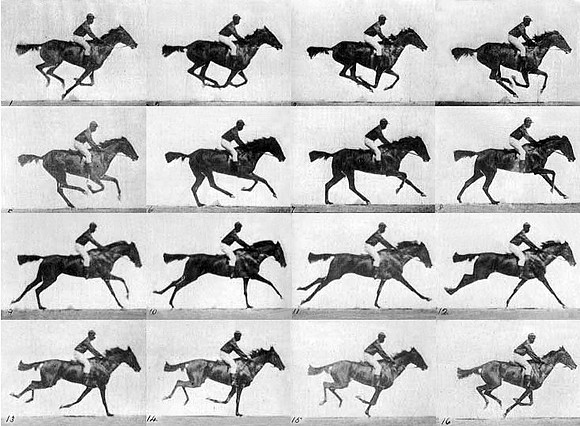
Horse Galloping by Eadweard Muybridge (1878) The development of high-speed photography in the 1870s led to radical changes in the human perception of time – and it was all the result of a wager over a galloping horse. Leland Stanford, a California railroad magnate, politician and racehorse owner, made a bet that all four hooves of a galloping horse lifted off the ground at the same time. The trouble was, he couldn’t prove it, because the unaided human eye couldn’t follow such rapid movement. So Stanford hired an English-born landscape photographer named Eadweard Muybridge to document a horse’s gait in a series of time-motion photographs. It took years to fulfill the assignment, because cameras were initially no better than the human eye in capturing fast movement. Muybridge was an inventor as well as a photographer, and he developed a high-speed shutter that did the trick. He rigged up a dozen cameras with trip wires along a stretch of racetrack, each designed to snap a picture as a horse galloped past. The resulting images of the galloping horse caused a sensation. People in the mid-19th century had adjusted to the “annihilation of time and space” from such speedy inventions as the railroad and telegraph. But until Muybridge, no one had succeeded in stopping time altogether. Exposure times for early cameras were so lengthy that it was initially impossible to capture anything that moved. You could photograph a busy street scene in broad daylight, and the street would appear empty, because only immobile objects would register on the glass-plate negatives. Muybridge ended all that with more photosensitive plates and a shutter device that reduced exposure times to 1/1000th of a second – hundreds of times faster than the blink of an eye. His photographs of a galloping horse did indeed show all four hooves lifting off the ground at the same time, and Stanford won his bet. Although mechanical clocks had been around since the 14th century, daily life continued to be governed by the rhythms of nature until the introduction of inexpensive pocket watches in the mid-1800s. Soon every shop foreman and railroad conductor was carrying one, and life was now regulated by the clock. When time was measured by the movement of the sun across the sky, it was regarded as cyclical and continuous. Clock-time was thought of incrementally: days, hours, minutes and then seconds. The idea of an instant in time had been around since the ancient Greeks. But Muybridge’s photographs enabled people to picture it for the first time: those four horse’s hooves suspended simultaneously above the racetrack. Inevitably, an instant came to be thought of as something hovering motionless in time. Muybridge went on to photograph numerous stop-motion series of animal and human locomotion, and he even invented a device called the zoopraxiscope to display moving images – a forerunner to Edison’s motion picture camera. Of course, what was displayed was not actual movement but a series of still images threading through a machine faster than the eye could register them. The brain was tricked into seeing motion where none existed. Zeno, a fifth-century BCE Greek philosopher, made a similar point about our perceptions of time and motion. He argued that an arrow in flight cannot really move, because at each instant the arrow hangs motionless in the air. Since an arrow can never be in two places at once, motion as such was impossible. His argument was one of a series of paradoxes meant to prove a point, but I suspect even he wouldn’t care to test it by stepping into the path of an actual arrow in flight, even if it theoretically couldn’t really be in two places at once. On the other hand, if motion is indeed real, then something else has to give. A young theorist from New Zealand named Peter Lynds argues that motion is possible only if you eliminate instantaneous time. He writes, "With some thought it should become clear that no matter how small the time interval, or how slowly an object moves during that interval, it is still in motion and it's position is constantly changing, so it can't have a determined relative position at any time, whether during an interval, however small, or at an instant. Indeed, if it did, it couldn't be in motion." But what does this say about Muybridge’s photo of the galloping horse? Presumably the horse was real. Its four hooves did indeed leave the ground at the same time, even if the unaided human eye couldn’t detect it. The photo itself is real. And yet it is also a fabrication, depicting a moment frozen in time in which the horse hangs motionless in the air, its four hooves forever off the ground. Such moments do not exist in reality. To be precise, moments themselves do not exist, those intervals of time without duration in which the action is interrupted and the ceaseless flow of life is brought to a standstill.
|