The Sun Is God
"The sun is God," the great English landscape painter J.W.M. Turner is supposed to have said before breathing his last. Anyone who knows anything about his work would, of course, instantly recognize the appropriateness of such an exit line, whether or not he actually said it. Turner’s canvasses have been described as “detonations of light,” and so they are. The sun does not so much dominate the sky as devour it in thick effusions of white and yellow and red. Generations before the Impressionists and Abstract Expressionists, Turner dispensed with form in favor of light and atmosphere. The art critic John Ruskin, an early champion of Turner’s work, acknowledged that he was something of an “infidel” and “a sun worshiper of the old breed.” Turner would stare directly into the sun for such extended periods that onlookers wondered how he could do so without destroying his eyesight. "It hurts my eyes no more than it would hurt yours to look at a candle," he assured them. Pagan though he might be, Turner’s fixation on the sun would apply in some measure to every landscape artist, not the least photographers like myself. If a good photograph is knowing where to stand, as Ansel Adams once said, then we might add it is knowing where to stand in relation to the sun. To begin with, you can’t point the camera directly at the sun, except at the extremes of the day. Shooting into the sun is possible at dawn and dusk only because the sun is actually below the horizon, its rays refracted in the atmosphere. Pointing a camera anywhere near the sun when it is much above the horizon will produce lens flare or a blown-out image. If the sun were indeed God, it might not appear in any photograph, but its light would announce its presence with every object it fell upon.
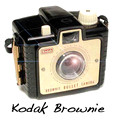
Kodak Brownie
Not long ago my son Matthew e-mailed photos he had taken with his latest smart phone while hiking with my wife on Sleeping Giant Mountain, not far from our home in Connecticut. I was struck by the technical excellence of the images, a far cry from the pictures you could take on my old Kodak Brownie, arguably the world’s first point-and-shoot camera. By the time my parents gave me one back in the 1950s, the Brownie had already been around for more than half a century. Apart from some modest technical improvements along the way, the Brownie was still essentially a simple box camera, with a rudimentary lens, viewfinder and shutter, along with a dial to advance the film in the camera. Easy to use, the Brownie was primarily marketed to kids; hence the name, which was taken from popular children’s book characters at the turn of the last century. Millions of those cameras were sold, but Kodak made its real money selling film, so the company did everything it could to encourage its customers to take lots and lots of pictures. The principal drawback to the Brownie, I quickly discovered, is that you had to send away to get your film processed and then wait days or weeks for your prints to be developed. Being a kid, I found this deferred gratification hard to take. And more often than not, the results were disappointing when the prints did show up, at least mine were. The camera soon found its way to the back of my closet and stayed there. Later I learned that Ansel Adams got his start taking pictures with a Brownie, which he presumably did not stash away in a closet. Polaroid solved the deferred gratification problem with an instant camera that developed its own prints right on the spot. However, the results weren’t much better than what you could get with a Brownie, and each print was one of a kind, so you couldn’t make copies for your family and friends. Recently someone asked me whether I had an old Polaroid she could borrow. I had to tell her I never owned a Polaroid camera, and if anyone still had one it was probably stashed away in the back of a closet somewhere. Film cameras of any kind have all but disappeared; indeed, cameras as such are limited to the die-hard few like me who still insist on fussing with lenses and dials before snapping a picture. Little did I imagine when I was growing up back in the 1950s that most people would one day be taking pictures with a telephone they carried around in their pockets. Or that their photos would be instantly available for transmission to the entire world via social media. Kodak’s long-ago dream of getting the masses to take lots and lots of pictures has been realized, but not with film cameras. Kodak sold off the last of its camera film business in 2013. Tableau Vivant
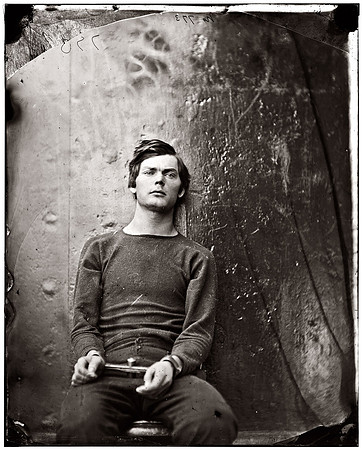
The black-and-white photograph shows a strapping young man sitting with his back against a riveted metal plate. He is clean-shaven and undeniably handsome. His gaze is directed toward the camera, his expression a bit hard to read. He could be pensive, sad, even a touch defiant. Is that a troubled look on his face? Judging by the fact that his wrists are manacled, he is certainly in trouble – a great deal of it, as it turns out. The young man is 21-year-old Lewis Powell (a.k.a., Lewis Payne or Lewis Paine), and he has been identified in a police lineup as the assailant who attacked U.S. Secretary of State William H. Seward with a knife on the same night that Abraham Lincoln was assassinated. Powell was photographed on board the ironclad vessel U.S.S. Saugus, where he was held after his arrest. Within two months he would be hanged along with three co-conspirators in a plot to assassinate the president and key cabinet officers. The significance of the photograph now becomes clear. When we return the unwavering gaze of this handsome young conspirator, we are looking into the eyes of a dead man.
For cultural critic Roland Barthes, Powell’s impending execution was the central fact about the photograph, which contained no clues to his fate beyond the manacles on his wrists. Every photograph, according to Barthes, bears the same unspoken message: that the person depicted is going to die, if he or she hasn’t already. His thesis was presented in his highly influential monograph on photography, Camera Lucida, published shortly before his own death in 1980. Each image sets up a dislocation of time in which the photograph’s subject dwells in a frozen present that points to a future that may already be past to the viewer. Thus, the young conspirator who stares fixedly into the camera on board the U.S.S. Saugus is forever going to die and is also dead. Barthes writes of the “terrible thing which is there in every photograph: the return of the dead.”
In selecting the portrait of a condemned man, Barthes might be accused of stacking the deck to make his case. However, Exhibit A was not the image of Lewis Powell but a family photograph that he deliberately omittted from his book. He wrote Camera Lucida soon after the death of his mother Henriette, to whom he was deeply devoted. She had raised him as a single mother, and he lived with her most of his life, caring for her during her final illness. Shortly after she died, Barthes came across a faded sepia snapshot of her as a child. This became the unseen centerpiece of the book, which he could not bring himself to reproduce because for his readers “it would be nothing but an indifferent picture." Although Henriette is no more than five in the snapshot, Barthes recognizes “the truth of the face I had loved,” and he weeps. "I tell myself: she is going to die: I shudder… over a catastrophe which has already occurred.” He goes on, “Whether or not the subject is already dead, every photograph is this catastrophe.” Granted, Barthes was still grieving when he wrote these words, but I wonder how many of us would describe the death of an elderly parent as a “catastrophe,” much less extend that description to everyone in a photograph, whether or not they were already dead. Certainly I have felt the pang of loss in looking at old photographs of people I have loved who, in one way or another, are now departed. I sometimes even get wistful looking at photographs of busy street scenes from a century or more ago, realizing that the people in them are all gone, every one of them. And yet what generally comes through to me is not that these people are dead but that they are alive, if only within the frame of a photograph. Indeed, the very fact that the subjects of these photographs appear to be alive is what gives them their poignancy.
For Barthes, the grammar of a photograph is always past perfect: “this has been.” I would suggest another formulation, borrowed from photographer Henri Cartier-Bresson, who said life is “once, forever.” By this he meant a photographer has one chance to capture the “decisive moment” in an image, after which it is irretrievably lost. However, there is also a sense in which the photograph itself is once, forever. The subject will always be there as it once was, a tableau vivant, if you will – not dead, as Barthes would have it, but forever alive. For example, I would like to think that Barthes’ mother Henriette is forever smiling in the photograph we never see of her as a little girl. After all, in the photograph at least, she still has her whole life ahead of her. A Photograph Is Once, Forever
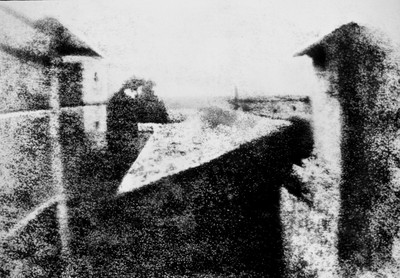
Facebook estimated in 2013 that its users were uploading 350 million photographs per day onto its servers, which works out to nearly a quarter of a million per minute. Altogether, we will soon reach the point where one trillion photographs are taken every year, most of which will wind up on the Internet. Long before social media and digital cameras, cultural critic Susan Sontag observed that we consume images at an ever faster rate. This is only partly due to technological innovations that make it easier to produce them. The human eye naturally seeks movement, and there may be an evolutionary advantage to our craving for novelty. Advertisers know they must provide more and more visual stimulation to keep us watching. Attention spans shrivel under the onslaught of imagery, which just feeds our appetite for still more. Now everybody is so busy taking pictures, we have forgotten how to see. We have become like the glutton at a feast who wolfs down his food without bothering to taste it. What will it take to get us to savor what we see? John Donne may have given us a clue. More than four centuries back he wrote, "There is nothing that God hath established in a constant course of nature, and which therefore is done every day, but would seem a miracle, and exercise our admiration, if it were done but once." Suppose instead of billions of photographs, there were only one? There was a time, of course, when there was only one. In 1826, a French inventor named Nicéphore Niépce used a primitive camera to capture the view from his window onto a polished pewter plate coated with bitumen (image above). Niépce’s invention, which he called the heliograph, failed to have much of an impact, but his business partner, Louis Daguerre, created a sensation a few years later with another photographic process named after himself, the daguerreotype. One commentator rhapsodized, “All nature shall paint herself — fields, rivers, trees, houses, plains, mountains, cities, shall all paint themselves at a bidding, and at a few moment’s notice.” To another critic, the wondrous alchemy that caused a fixed image to appear on a metal plate or piece of paper was “divine perfection” – exactly the sort of miracle John Donne was talking about when natural processes are seen as if for the first time. As a fine arts photographer, I am certainly aware that I am pursuing a specialty craft in a commodity market. Anybody with a smart phone these days can take pictures that are technically quite good. Yet I stubbornly hope for a miracle -- that out of the billions of images out there I will produce one that can stand as if it were the only one. Every artist worth his or her salt does the same. The impulse is not as grandiose as it may sound – quite the opposite in fact. We are merely responding the best we know how to what we are privileged to see. In the end, it is not so much the image that is unique but the things God has established in the constant course of nature. Once you have learned to see them as they truly are, you realize that everywhere you look there is some miracle waiting to be captured on the fly. As the photojournalist Henri Cartier-Bresson put it, “Life is once, forever.” So is a good photograph. Lines
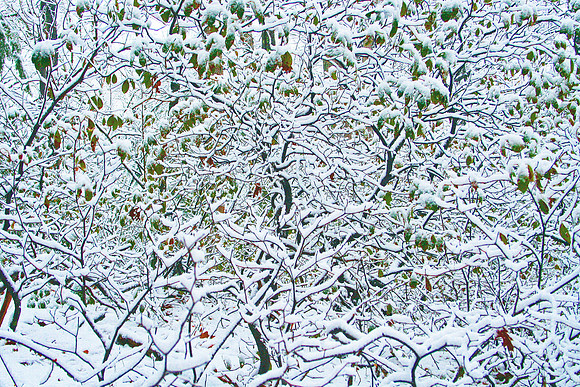
"Apologies to Jackson Pollock" by Eric Rennie Living as I do with a state park at the end of my street, I am often able to get there with my camera after a snowfall before the trails are marked by hikers and snowmobilers. Rounding a corner along the edge of a ravine some years ago, I came upon a thick tangle of snow-covered branches. I took some pictures, and when I later uploaded them to my computer I realized they bore more than a casual resemblance to the work of the Abstract Expressionist painter Jackson Pollock; hence, the title of the image above. "Apologies to Jackson Pollock" appears in a juried competition called "Lines" at the Darkroom Gallery in Essex Junction, VT. Curated by Rebecca Senf, the show runs from February 27, 2015 to March 22, 2015. |