Toward the Light
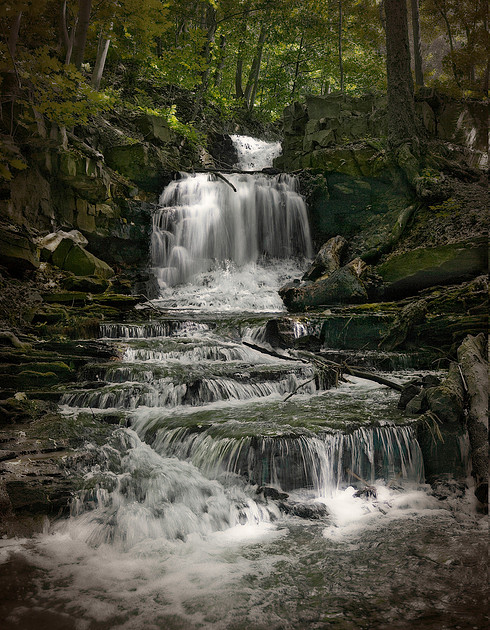
"Ice Falls" by Eric Rennie Studio photographers have the advantage of being able to move props and lights around until they get the effects they want. If you mostly shoot landscapes, like me, there is no moving rocks and trees around, and the lights follow their own path in the heavens. This does not mean you must always take things as you find them. But if you want to achieve certain natural lighting effects, you need to wait until the light moves to where you want it. To say that the sun rises in the east and sets in the west tells you very little. Where I live in New England, the sunrise moves in a 64-degree arc along the horizon from the winter solstice to the summer solstice. If you are shooting close by, you may already have a good sense of when and where the sun will rise and set. But if you are venturing farther afield, you might need to consult an ephemeris. An ephemeris was originally a chart giving the positions of the sun, moon and planets for any time of day at a given location. Computers now do this automatically, and there is even an app for photographers that plots this information on Google Maps for any location in the world. As an example, I recently wanted to photograph a frozen waterfall after a long stretch of sub-zero weather. The waterfall was located in a state park about 40 minutes from my home. I had been there before but not for many years. The photographer’s app gave me a Google map of the site with an overlay showing the times and directions of the rising and setting sun. There was even an overlay showing the sun within six degrees of the horizon at dawn and dusk, a time of day when the light is generally considered most favorable for outdoor photographs. Armed with this information, I had a pretty good idea when the lighting conditions would be most favorable for my shoot without having to scout out the site beforehand. The result is the photograph above, which is on display from June 19, 2015 to August 2, 2015 at the 104th annual exhbition of the Connecticut Academy of Fine Arts at the Mystic Arts Center in Mystic, CT. Let’s say you have an assignment from National Geographic to photograph the sun rising over the Heel Stone at England’s Stonehenge monument on Salisbury Plain. You could consult the ephemeris app. Or, if you had done your homework on Stonehenge, you would already know that the sun comes up over the Heel Stone each year at the summer solstice when viewed from the center of the monument. It turns out that Stonehenge itself is a kind of ephemeris, with its massive stone megaliths aligned to the positions of the sun and moon at certain junctures. Boston University astronomer Gerald Hawkins determined in the 1960s that various alignments of the megaliths pointed to solstices, eclipses and equinoxes. Hawkins’ findings were initially challenged by archeologists who doubted that the Neolithic peoples who erected Stonehenge in stages over 1,000 years had the knowledge to build a sophisticated astronomical observatory. Yet somehow people who lacked even such basic technology as the wheel were able to drag 40-ton stone slabs 25 miles across Salisbury Plain and precisely align them to the movements of celestial bodies. It has since been determined that other megalithic sites in Britain are oriented toward the sun and moon. Evidence of similar directional orientation goes back much farther. Excavations of Neanderthal settlements have found that dwellings, ritual sites and graves all faced toward the rising sun. From the time Christians first emerged from the catacombs, they built their places of worship in “high and open places, facing the light,” in the words of Tertullian, one of the early church fathers. This led many pagan onlookers to conclude that Christians must be sun worshippers. Reinforcing this notion was the fact that priests were instructed to celebrate the Mass facing ad orientem (toward the east). Various explanations are offered for why Christian churches and rituals are directed toward the east. Many churches were built on earlier pagan religious sites, which faced east. Jesus was identified in the New Testament with the Jewish high priest who performed sacrifices facing east at the temple in Jerusalem. The rising of the sun in the east is symbolically associated with Christ’s Resurrection and the Second Coming. As for the directional orientation of Stonehenge, its Neolithic builders left behind no written records that might have explained its significance. Was Stonehenge an astronomical observatory, a religious shrine or both? Priests doubled as astronomers among the Babylonians and other ancient civilizations. In the end, whatever the rationale, I suspect we align our sacred shrines as we do for the same reason that photographers point their cameras as they do, to revel in the light. Natural Realm
"Cascade II" by Eric Rennie My photograph above was one of 61 selected for an exhibition called Natural Realm, which runs from June 25, 2015 to July 19, 2015 at the Darkroom Gallery in Essex Junction, VT outside Brattleboro. The image was taken last year at Dividend Pond in Rocky Hill, CT, not far from where I live. The show's curator is photographer, author and teacher Dan Burkholder. A Shot in the Dark
"Fireworks Finale" by Eric Rennie A digital camera is essentially a computer with a lens attached to it. Its functions are fully automated, so you can take decent pictures without having to do much more than point the camera and shoot. Everything changes, however, when you shoot in the dark. To get decent pictures, you have to switch to manual mode and make careful adjustments to ISO settings, shutter speed, aperture and focus. A lot of this is trial and error. ISO settings should be as low as possible so you don’t wind up with a lot of image noise – the digital equivalent of graininess in film images taken in low light. Automatic focus doesn’t work well in the dark, and manual adjustments aren’t much better because you can’t see clearly. And since exposure times are now calibrated in seconds rather than fractions of a second, you are better off using a tripod and shutter release cable; otherwise, your images are likely to be spoiled by camera shake. At least with digital cameras, you are not using up a lot of film trying to get the picture to come out right – and you don’t have to wait for your film to be developed to find out. The limitations of cameras shooting in the dark point up just how well engineered the human eye is by comparison. As you may remember from biology class, our eyes have two kinds of photoreceptor cells: cones, which work best in bright light; and rods, which are much more numerous and can be triggered by a single photon, making them most effective in low light. Together they enable the human eye to maintain sensitivity to brightness over nine orders of magnitude (about one billion times). The eye adjusts automatically to changes in illumination, although it may take the rods a half hour or longer to adapt fully to darkened conditions after exposure to bright light. The image above is one of two appearing in a juried competition called "After Dark IV" at the Greg Moon Gallery in Taos, NM. The all-media exhibit, which runs from June 6 to June 27, 2015, is a "a show celebrating darkness and the varied reactions emblematic to this subject matter." The jurors are JUXTAPOZ magazine co-founder and gallery owner Greg Escalante and curator Joe Buffalo Nickels. The photo was taken several years ago at a July Fourth fireworks display held at Stanley Park in New Britain, CT. My other entry, entitled "Clown God," appeared in shows on opposite coasts last fall. Two Exhibits
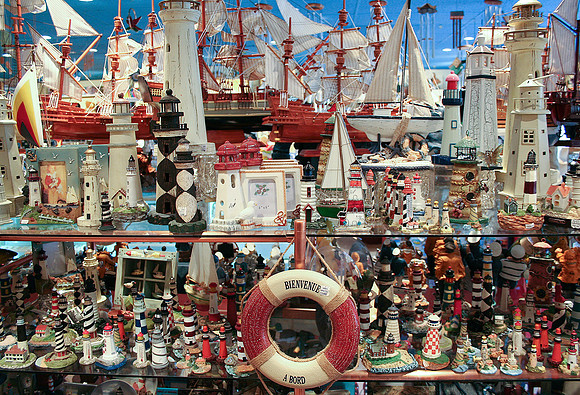
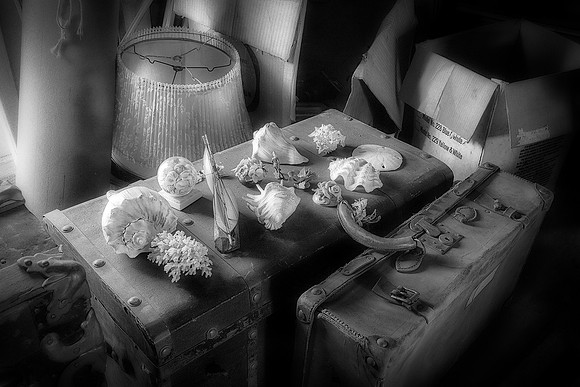
"Bienvenue a Bord" by Eric Rennie Two of my photographs are appearing in juried competitions this month. The one above, taken in a gift shop on the Gaspé Penisula in Quebec, appears in an exhibit called "H2O" sponsored by the A. Smith Gallery in Johnson City, TX starting May 22, 2015. Everything in the picture is entirely nautically themed, even though not a single drop of water actually appears in it. The image below, also nautically themed, is part of Peter Miller Fine Art Gallery's First International Open Call Show opening May 21, 2015 in Providence, RI. As it happens, this photograph was previously part of an exhibition at the A. Smith Gallery.
"Attic Treasures" by Eric Rennie Stop Time
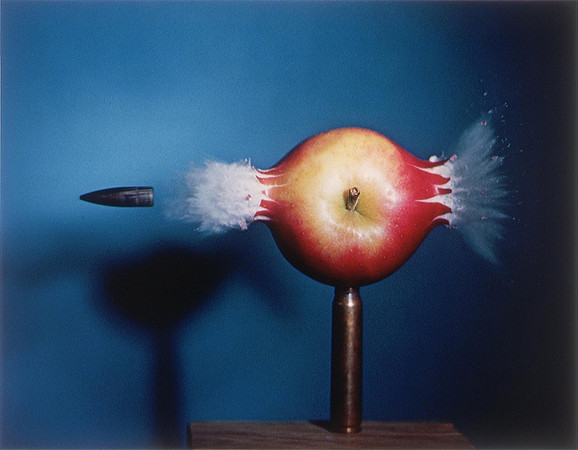
Harold Edgerton may have been the only electrical engineering professor from MIT ever to have his scientific work displayed at New York’s Museum of Modern Art (MOMA). His stop-motion image of a milk drop splashing in a plate of the liquid was included in MOMA’s first photography exhibition in 1937 and is now part of its permanent collection. Edgerton had pioneered the use of a stroboscopic flash synchronized with a high-speed camera to capture motion that was otherwise too rapid to be detected by the human eye: a .30 caliber bullet passing through an apple at 2,800 feet per second, a hummingbird’s wings in flight, a balloon bursting, an arrow flying from an archer’s bow at the moment of release. To create these images, he used exposures as short as one third of a microsecond (one millionth of a second). In perhaps his most audacious undertaking, Edgerton and his colleagues photographed a nuclear explosion at the instant of its detonation, using specially designed equipment that had no mechanical shutter and that enabled them to take exposures as brief as one ten-millionth of a second. No wonder Life Magazine dubbed him “the man who stopped time.” Although Edgerton made significant technical advances in coupling stroboscopic flashes with high-speed cameras, he was not the first to create a sensation with stop-motion photography. A landscape photographer named Eadweard Muybridge did a series of animal locomotion studies in the 1870s using a high-speed shutter he had invented to prove that all four hooves of a galloping horse left the ground at the same time. Until the mid-19th century, exposure times were too slow to capture movement at all. This explains why Matthew Brady mostly photographed the dead rather than the living in Civil War battles, because corpses didn’t move. Early photographs of crowded city streets appeared nearly empty, because the glass-plate negatives were incapable of registering moving figures. When faster exposure times finally allowed photographers to capture busy street scenes, Oliver Wendell Holmes was astonished by the awkward poses of pedestrians caught in mid-stride. “Is motion but a succession of rests?” he wondered. “Motion is as rigid as marble, if you only take a wink's worth of it at a time.” Holmes had put his finger on a problem that had puzzled philosophers since at least the time of Zeno of Elea in the 5th century BCE. At any given moment, the world appears at a standstill, so how can anything move? As if inspired by one of Edgerton’s photographs, Zeno argued that an arrow in flight is really motionless because in any particular instant it can only occupy a space equal to itself. If an arrow can only occupy a space equal to itself, how does it advance to the next moment, when it also appears to hover motionless in the air? Zeno used this and other paradoxes to show that motion was an illusion. And yet, if you stood in the path of that arrow, you were liable to discover otherwise, which meant that something else had to give. The problem may not be motion as such but in the idea of a moment, an infinitesimal slice of time made concrete in those photographs of bullets piercing an apple or an arrow in flight. Photographs appear to be instantaneous, but they are not really. A moment, by definition, has no duration, but a photograph with zero exposure time would show nothing. Even Edgerton’s images of nuclear detonations required a ten-millionth of a second of exposure time. That’s a ten-millionth of a second of motion as light traveled from an exploding hydrogen bomb and left an imprint on exposed film. Edgerton’s photographs appeared to stop time in its tracks, but all he really did was slow it down enough so motion too rapid for the human eye could be seen. Early one frigid winter’s morning I ventured out with my camera and tripod to take pictures at a colonial-era mill site not far from my home in Connecticut. All that remained of the mill was a stone retaining wall by a waterfall at one end of a long pond. As I picked my way along a snowy path from the parking lot, I could hear the rush of water. But when I got to the retaining wall at the top of the falls, all I could see at first was snow and ice below. Then in a small gap in the snow, I saw a thin carapace of blue ice and beneath it rapidly flowing water. And so it is with time – not time as we usually think of it, an abstract measure of change that we neatly segment into past, present and future, nor those frozen slices of time that we capture in photographs, but time as we actually experience it lying below the surface of thought: free flowing, indivisible, inexorable, the onward rush of life. As the philosopher Henri Bergson once wrote, “We do not think real time, we live it.” According to one estimate, some 880 billion photographs are taken every year, and that number will soon top one trillion. I doubt people give much thought to what they are doing when they take a picture. They are looking for a keepsake, a reminder of happy times: an evening out with friends, a church picnic, a new addition to the family, a wedding or a baptism. It is life that they seek, but life as it has never existed in the slipstream of time, life that lasts forever. Photographic images are taken from life like pages torn from a book. They seem so real, so of-the-moment. And yet those images, like the moments they appear to capture, are essentially an illusion. |