Nothing You Can See that Isn't Shown
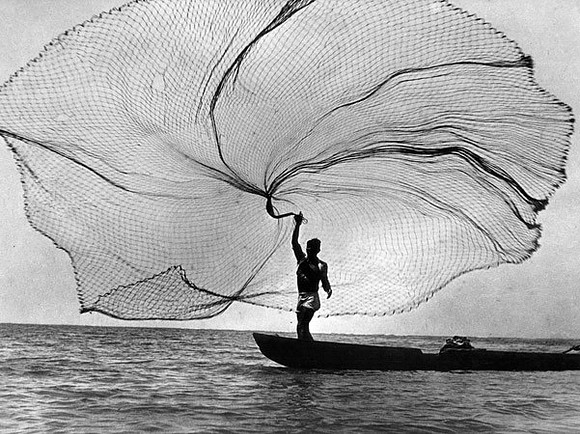
Photograph by Henri Cartier-Bresson
I did not take up photography as a spiritual exercise, but that is what it became once I realized that the aims of photography and of meditative practice are essentially the same. Buddhists call it “clear seeing” – learning to perceive what is actually there rather than what we think is there. We think we see the world as it is, but the philosopher Owen Barfield has noted “the perceptual world comes over its horizon already organized.” The mind seeks to make sense of its environment by applying concepts, attitudes and judgments to raw sensory experience, including such fundamental concepts as time and space. These reflexive mental processes are no doubt essential to our ability to navigate the world. But we inevitably fall back on habitual modes of thought and feeling rather than experiencing life as it actually is at this moment.
A curious thing can happen when the world is seen – really seen -- through the lens of a camera. The larger world of context falls away, and we are confronted by pure color, form, texture, light and shadow. There is no subject as such, at least none that we can put words to at this moment. “To see is to forget the name of the thing one sees,” the poet Paul Valéry said. Once we put words to it, we are in the realm of thinking, not seeing. There is no calculation in the realm of unadulterated seeing. We do not click the shutter because we think what we see in the viewfinder will make a good picture. We are more like the Zen archer who releases his arrow at just the right moment without aiming. The picture takes itself.
The photographer Henri Cartier-Bresson talked about the “decisive moment” when color, form, texture, light and shadow come together just so. "Photography is not like painting," he told a Washington Post writer. "There is a creative fraction of a second when you are taking a picture. Your eye must see a composition or an expression that life itself offers you, and you must know with intuition when to click the camera.” Having begun as a painter himself, Cartier-Bresson compared photography to a quick sketch “done with intuition, and you can’t correct it. If you have to correct it, it’s the next picture. Life is very fluid. Life is once, forever.”
Cartier-Bresson, a photojournalist and street photographer, began taking pictures in the 1930s using a Leica with a 50mm lens, which allowed him much greater spontaneity than earlier box cameras. To capture life on the fly, he said, you had to be like an animal with its prey. As a landscape photographer working with a digital camera and tripod, I don’t need to be nearly as quick about it. I can afford to lie in wait for the moment, but it always comes down to the moment: the sun coming up over the horizon, the fog burning away in the summer heat, the clouds moving across the sky, reflections dancing on the water, the continuous play of light and shadow. This is what life itself offers me in the moment. “You can’t look for inspiration,” Cartier-Bresson insisted, which may sound confusing, since he was always looking. Here he was making a distinction between seeking and seeing. To look for something is to seek it, as opposed to recognizing it when you see it. The initiative here is not with us but with whatever it is that chooses to reveal itself to us in the decisive moment. All we have to do is to pay attention.
Keywords:
cartier-bresson,
clear seeing,
decisive moment,
owen barfield,
photography,
spiritual,
zen
|
Archive
January
February
March
April
May
June
July
August
September
October
November
December
|