Affinity
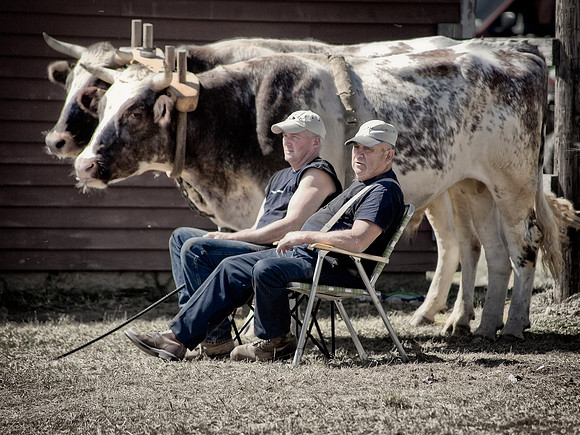
"Man and Beast" by Eric Rennie The image above is one of 27 selected for an international exhbition juried by photographer S. Gayle Stevens at the Amblewood Gallery outisde Atlanta. The show, entitled "Affinity," opens February 20, 2016. The picture was taken at an ox pull at a town fair in Guilford, CT. Ordinary
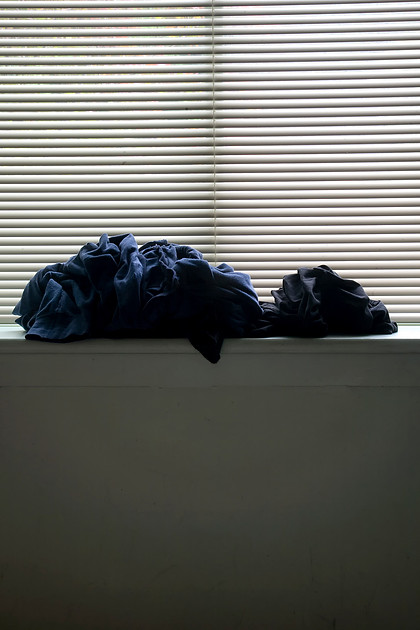
ordinary (adj.) early 15c., "belonging to the usual order or course," from Old French ordinarie "ordinary, usual" and directly from Latin ordinarius "customary, regular, usual, orderly," from ordo (genitive ordinis) "order" I was sitting on the edge of my bed the other morning getting dressed when I glanced up and saw nothing out of the ordinary. A ratty old pair of blue pajamas and a black T-shirt were bunched up on the windowsill, awaiting the hamper. The slats of the venetian blinds were still closed. A soft, silvery light seeped into the room. Fortunately, I was able to break away from my thoughts long enough to really see what I was looking at, and I realized it was beautiful. I ran downstairs to get my camera and tripod, which I set up by the side of my bed. I took some shots of my laundry on the windowsill, bathed in the soft morning light. My wife was in the adjoining bathroom getting ready for the day. It occurred to me that I would have to explain to her what I was doing taking pictures of my dirty laundry. But my wife has gotten used to odd behavior of this sort by now. Normally when we speak of something being ordinary, we mean it is commonplace, like a pile of dirty laundry on its way to the hamper. So why bother to take a picture of it? In this case, I took the picture because I saw that the early-morning light falling on the folds of my pajamas and T-shirt was beautiful. Yet it was nothing I hadn’t seen a thousand times before without noticing how beautiful it was. Why not? The short answer, I think, is that most of the time we are too busy getting on with our lives to take proper notice of such things. In Thornton Wilder’s play, Our Town, a young woman named Emily, who has died in childbirth, is allowed to return to her life for a day and is dismayed at how distracted everyone seems. "Oh, earth, you're too wonderful for anybody to realize,” she laments. “Do any human beings ever realize life while they live it?" Aldous Huxley provided an answer in his long essay, The Doors of Perception, which chronicled an early experiment with the hallucinogenic drug mescaline. When we say that such drugs heighten awareness, we assume they act as some sort of brain booster. But Huxley arrived at the opposite conclusion. He hypothesized that the brain functioned as a “reducing valve” to filter out the otherwise overwhelming volume of sensory stimuli coming at us from very direction. Brain imaging experiments have since confirmed that hallucinogens bypass the brain’s sensory-inhibiting mechanisms, enabling us to experience reality as it is actually presented to us. To paraphrase Timothy Leary’s famous mantra, “Turn on, tune in, drop out,” we tune in by turning down our brains. British researcher Robin Carhart-Harris notes that “a lot of brain activity is actually dedicated to keeping the world very stable and ordinary and familiar and unsurprising.” No doubt the brain has sound evolutionary reasons for doing this. How are you ever going to get on with your life if you are constantly mesmerized by such things as a pile of dirty laundry on the windowsill in your bedroom? The stakes were even higher for our Pleistocene ancestors, who had to keep their senses narrowly focused on the business at hand, whether it was to find something to eat or to avoid being eaten themselves. For a visual artist, a world that is stable, ordinary, familiar and unsurprising is a problem, because it is boring. The good news is that the world doesn’t have to be this way, and you don’t need to take hallucinogenic drugs to undo the brain’s sensory-inhibiting mechanisms. Nor do you have to twist yourself into a pretzel on the floor staring at a wall for a thousand lifetimes while counting your breaths. Reality as it actually presents itself to us isn’t invisible, and it’s not hidden behind some impenetrable psychic barrier. It is hidden in plain sight, and if we don’t see it, it is only because we have dismissed it as ordinary and have turned our attention elsewhere. With a little patience we can train ourselves to turn our attention from elsewhere to here, and then we just might discover there is no such thing as ordinary. In Celebration of Trees
"River Highlands Trail in Winter" by Eric Rennie The image above is one of 40 chosen for an online exhibition called "In Celebration of Trees" at the Photoplace Gallery in Middlebury, VT running from January 20 to February 15, 2016. The juror is Tom Zetterstrom. The photo was taken soon after a snowfall at a state park within walking distance of my house. Gathering
"Aunt Mildred's 100th Birthday Party" by Eric Rennie The image above has been awarded an honorable mention in a juried competition called Gathering at the A Smith Gallery in Johnson City, TX, near Austin. The photo was taken at my aunt's 100th birthday party when she was still living alone at the family farm in Blackstone, MA. She later moved to a convalescent home near two sons in Maine. At the time of her death at age 106, she was reputedly the oldest resident in the state. Another of my photographs, entiled "Vets," is also part of the exhibit, which runs from January 8, 2016 until February 14, 2016. The juror for the show is photographer Jennifer Shaw. The Eye of the Beholder
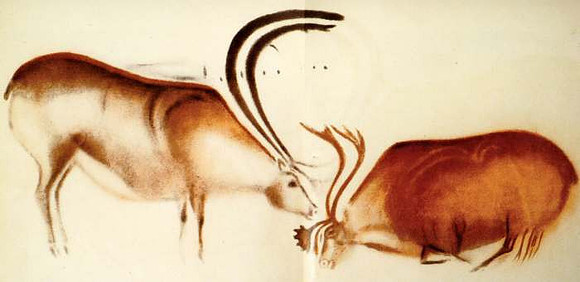
17,000-Year-Old Lascaux Cave Painting Beauty, we are told, is in the eye of the beholder. But why, apart from human reproductive urges, do we have an eye for beauty at all? According to evolutionary theory, the traits that get passed on to future generations must have some selective advantage in assuring the survival of the species. Humans are born with an eye for color and movement, which stands to reason. You want to keep a sharp eye out for things to eat – or for things that might eat you. But it’s frankly hard to see where aesthetics fit into Darwin’s scheme.
Not that people haven’t tried. There is a theory called evolutionary aesthetics, which argues that aesthetic preferences are globally present in human societies and therefore must be hardwired in our genes rather than being culturally determined. However, natural selection only gets you so far in explaining how art appreciation gave our hominid ancestors a leg up in their struggle for survival. We are on solider ground invoking sexual selection, which goes back to those aforementioned reproductive urges. The example Darwin himself used is the peacock’s tail, which is a useless extravagance from a strict survival-of-the-fittest standpoint but makes perfect sense if you are looking to attract peahens with an eye for colorful feathers. Philosopher Denis Dutton argued that the “art instinct” – the human equivalent of the peacock’s tail – first emerged among hominids during the Pleistocene period some 1.6 million years ago as an indicator of reproductive fitness. Why artistic talent or temperament should be an indicator of reproductive fitness isn’t entirely clear, except perhaps as a mark of broader intelligence.
Even Denis Dutton was prepared to concede that the case for evolutionary aesthetics was speculative at best, if not downright fanciful. After all, we are some 80,000 generations removed from the supposed origins of the art instinct, and there is no written record or even cave art to document it until much more recently. Clearly, something happened along the way that led to the rapid enlargement of hominid brains and the emergence of anatomically modern humans with a capacity for language, abstract thinking and aesthetic appreciation, among other things. But what exactly?
As long as we are indulging in speculative (if not downright fanciful) thinking, I have my own theory to propose. According to one of the oldest written records we have, God created the heavens and the earth in six days and judged them to be good. The Hebrew word translated as “good” in the Genesis creation story literally means “that which gratifies the senses and derivatively that which gives aesthetic or moral satisfaction” -- beautiful, in short. The adjective is used seven times in the first chapter of Genesis as God contemplated his handiwork and pronounced it beautiful: first the light, then the earth and the seas, the plants and the trees, the separation of light from darkness, the sea creatures and birds of the air, the wild animals of the earth and the cattle of every kind. Finally, he beheld everything that he had made and found it to be beautiful. Curiously, the narrative does not specifically mention that the Lord judged the creatures he had made in his own image to be beautiful. But then, he did not need to; they could see it for themselves. What does it mean to be made in God’s image, if not to see the world as he does, in all its extravagant beauty?
|