Be Square
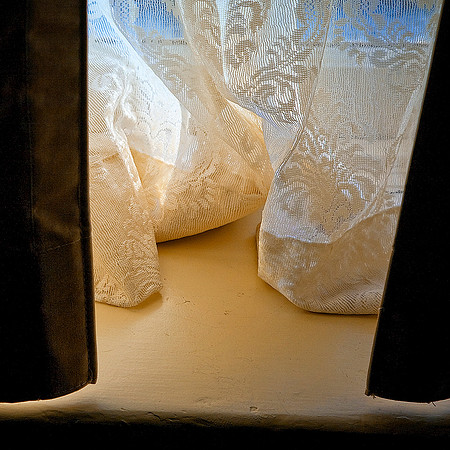
"Lace Curtain Window" by Eric Rennie The image above appears in a juried competition called "Be Square" at the Southeast Center for Photography in Greenvile, SC from December 4 to Deceber 28, 2015. The juror is Christophe Dillinger, a photographer and editor of Square magazine, a web publication dedicated to the square format. The photo was taken on my birthday several years ago in a hotel room in Annapolis, MD. Square formats are relatively rare unless cropped that way -- not the least because most cameras use rectangular formats. Images on my Canon 5D are shot with a 3:2 ratio, whether vertical or horizontal. Since I was taught to visually compose images using all four corners of the viewfinder, the resulting photo tends to come out as a rectangle, even if I end up doing some cropping here or there. Occasionally, however, a squared-off composition may present itself once I have had a chance to see the unedited image on a computer screen, as happened with the photograph above. If the composition works well as a square, I will go for it, because there is something very satisfying about the shape. Dazzled by Color Patches
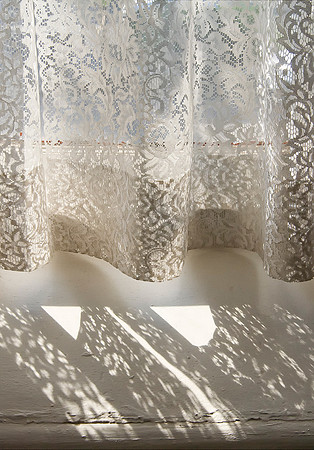
"Scrollwork" by Eric Rennie I was in a sitting room recently outside a small chapel next to the main sanctuary of the church I attend. I glanced over at the tall window on my left as I was passing through and was struck by the morning light streaming through a lace curtain. It was all enfolded scrollwork in pale ivory, casting intricate shadows on the sloping sill beneath. I reached into my shoulder bag for my camera and began snapping pictures. A squared-off version of the image above is one of 18 works on display from November 27, 2015 through December 31, 2015 at the Midwest Center for Photography in Wichita, KS in an exhibit entitled Ten X Ten. Each photograph is ten inches by ten inches and sells for $100. The Dark Side
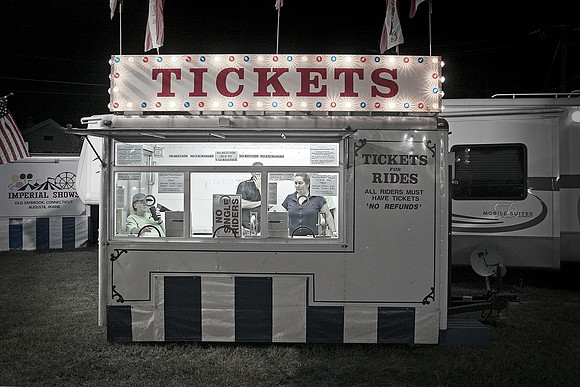
"Tickets" by Eric Rennie My photograph "Tickets" is among 60 images appearing in an exhibition of night photography opening on Halloween at the 1650 Gallery in Los Angeles. The juror is gallery owner Andrew Overtoom, an L.A. filmmaker and photographer. The picture was taken at a local carnival seven years ago, when taking technically proficient pictures was still a hit-or-miss affair for me (it's still a hit-or-miss affair!) Sight Unseen
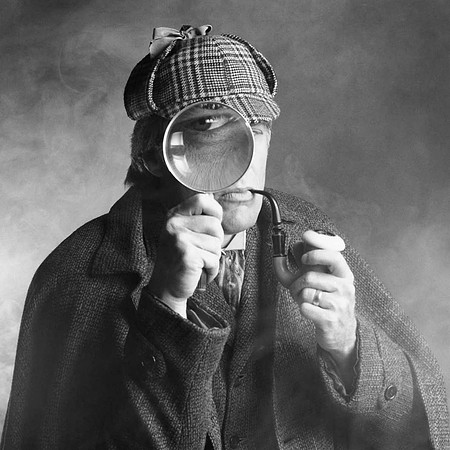
William Gillette as Sherlock Holmes “You see, but you do not observe,” Sherlock Holmes scolded Dr. Watson in A. Conan Doyle’s “A Scandal in Bohemia.” He added, “The distinction is clear.” Indeed it is, although it still matters what you are looking for. To prove his point, Holmes had asked Watson how many steps led up to their apartment at 221B Baker Street, which Watson was unable to answer. “Now, I know that there are seventeen steps, because I have both seen and observed,” Holmes continued. He did not bother to explain why he had counted the steps to their apartment, leaving one to suspect that his “extraordinary genius for minutiae,” as Watson characterized it, might have been symptomatic of Aspergers Syndrome or something similar. Holmes was determined to keep his mind uncluttered by anything but “the tools which may help him in doing his work,” which explains why he was so shockingly ignorant of literature, philosophy and politics. And so, while he might both see and observe things that most people didn’t bother to notice, Holmes only took in what might help him solve crimes.
Still LIfe 2015
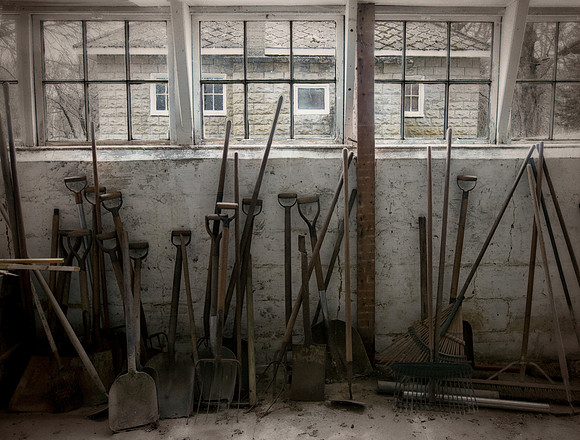
"Tool Shed" by Eric Rennie The photo above is part of a juried competition called Still Life 2015 running from October 2, 2015 to October 31, 2015 at the Center for Fine Arts Photography in Fort Collins, Colorado. The juror is Del Zogg, a curator of photography at the Museum of Fine Arts in Houston. The image is part of a series taken on a small dairy farm where my father grew up outside Blackstone, Massachusetts, a mill town on the Rhode Island border. My grandfather purchased the farm in 1910 and delivered milk directly to customers in neighboring towns. Mapledale Farm, as it was then called, had already ceased to be a working dairy operation long before I first visited in the early 1960s. My father sold the cow pastures to a developer decades ago, and much of the original pastureland is now a suburban subdivision. The house, barns and storage sheds remained on 2-1/2 acres. The oldest part of the house dated from the 1840s, and the interior still appeared much as it did when I first visited 50 years ago. The property was sold several years ago after my 103-year-old aunt was no longer able to live there on her own. |