Interiors
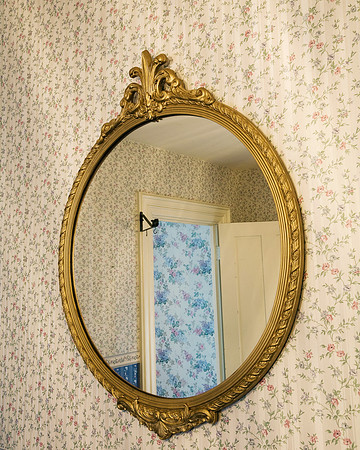
The image above was awarded first place in a juried competition entitled "Interiors," which is sponsored by the New York Center for Photographic Art. It was one of 45 photographs accepted out of 750 submissions. The exhibit runs from April 19, 2016 through April 30, 2016 at the Jadite Gallery in New York. The juror is Stephen Perloff, founder and editor of The Photo Review, as well as a photographer himself. The photo is part of my Mappledale Farm series taken on the small dairy farm where my father grew up. The Abandoned Landscape
"Cotton Hollow" by Eric Rennie The image above is one of 35 photographs appearing in a juried competition entitled The Abandoned Landscape at the Southeast Center for Photography in Greenville, SC. The show runs from April 1, 2016 to April 25, 2016. The juror is Laura Campbell, publisher of Looking Glass Magazine. The picture was taken last fall at the Cotton Hollow Preserve along Roaring Brook in Glastonbury, CT. These are the ruins of a cotton mill built some 200 years ago. A Blind Eye
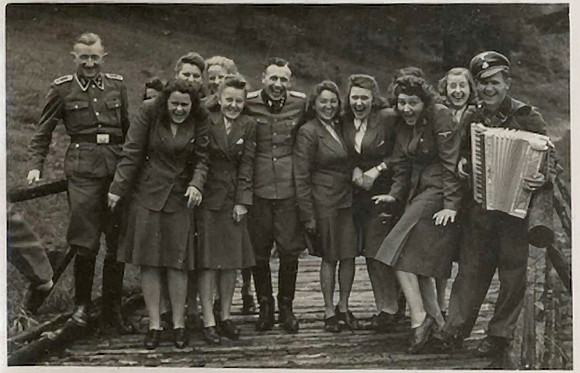
The SS at Play, 1944 -- Snapshot by Karl Höcker (United States Holocaust Memorial Museum) The United States Holocaust Memorial Museum in Washington, D.C. mounted a remarkable online exhibit of images from a recently donated photo album that once belonged to Karl Höcker, adjutant to the SS commandant at the Auschwitz-Birkenau death camp in Poland during the closing months of World War II. The photographs are remarkable principally for how strangely unremarkable they are. Höcker is seen playing with his German shepherd, lighting candles on a Christmas tree and hobnobbing with Nazi higher-ups, the most notorious of whom would later be hanged for war crimes. There are also shots of more formal occasions, including the dedication of an SS field hospital and a military funeral for officers killed during an Allied bombing raid in December, 1944. There are no clues within the album that Höcker and his colleagues presided over a large-scale industrial enterprise that exterminated more than one million Jews, gypsies and other “undesirables” between 1942 and early 1945. You see no barbed wire, no prisoners, no gas chambers, no smoking crematoria, nothing that could be later used to connect Höcker with the crimes that occurred at Auschwitz-Birkenau. It is doubtful that Höcker was the least bit concerned about covering up his crimes when he compiled the album. The photographs were not meant to document his role at Birkenau but rather to show how he saw himself as a rising young SS functionary. Before he joined the SS in the early 1930s, Höcker was a bank clerk, a job he would return to after the war. He was clearly proud of his close association with Richard Baer, the camp commandant, whose photograph appears on the album cover along with his own. As his album attests, Höcker was now able to rub shoulders with senior Nazi functionaries, including Baer’s predecessor, Rudolph Höss; Josef Kramer, the notorious “Beast of Belsen”; and Dr. Josef Mengele, who performed grotesque medical experiments on arriving Hungarian Jews. The photo album suggests that Höcker’s wartime duties left plenty of time for hunting parties, sing-alongs and social gatherings with pretty young SS women auxiliary members. When Höcker was eventually tracked down after the war and placed on trial for his role in the Final Solution, he claimed never to have witnessed the execution of an inmate. He testified that he had played no role in the process of selecting arriving prisoners for immediate death or for assignment to a slave labor camp. His album includes no photographs of the ramp where these selections took place, nor was there any testimony at his trial placing him there. He was ultimately convicted only of transporting Jews to Auschwitz-Birkenau, for which he served a seven-year prison term. Rudolph Höss, who was hanged by Polish authorities in 1947 for his role as the first commandant at Auschwitz, protested that he had been unjustly vilified. “May the general public simply go on seeing me as a bloodthirsty beast, the cruel sadist, the murderer of millions, because the broad masses cannot conceive the commandant of Auschwitz in any other way,” he wrote. “They would never be able to understand that he also had a heart and that he was not evil.” Hannah Arendt coined the term “banality of evil” to describe Adolf Eichmann, another functionary like Karl Höcker who joined the SS to advance his career and who was utterly incapable of grasping the moral consequences of his actions. The true horror of the situation is that monstrous deeds were committed by those who, in every other respect, never rose above the ordinary. How can this be? In The Nazi Doctors, Robert Jay Lifton observed that physicians assigned to the death camps commonly adopted a second self capable of sending people to their deaths while continuing to regard themselves as good doctors and family men. As Karl Höcker’s photo album so chillingly demonstrates, evil always turns a blind eye toward itself. Graven Image
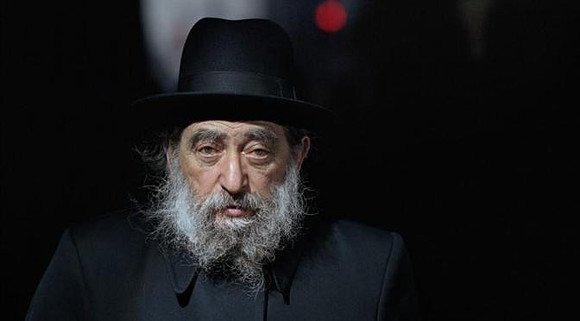
In 2001 the Pace/MacGill Gallery in New York mounted an exhibit of Philip-Lorca diCorcia’s large-format photographs of pedestrians on a sidewalk in Times Square. DiCorcia had rigged strobe lights to scaffolding across the street and aimed his telephoto lens at a particular spot about 20 feet away. The pedestrians were unaware that they were being photographed. The subject of one of the pictures, a retired diamond dealer named Erno Nussenzweig, came across his image in an exhibit catalog and filed suit, claiming that his privacy had been invaded. A Hasidic Jew, Nussenzweig also objected that the photograph violated religious strictures against the making of “graven images.” Although street photography was a long established practice in New York and elsewhere, the Nussenzweig case was the first legal challenge. The courts eventually ruled that diCorcia’s right to free artistic expression under the First Amendment trumped Nussenzweig’s privacy rights. The judges’ opinion conceded that the plaintiff may have found the photograph deeply offensive on religious grounds but determined there was no redress of this grievance in civil courts. Like most photographers, I am sensitive to the etiquette of taking pictures in public places. Normally, I will ask permission before photographing a stranger at close range. However, this is not always possible or even desirable, especially when there are time constraints. Then there is the problem of “camera face” – the pasted-on grin we habitually display whenever a camera is pointed in our direction. If we want a more natural look, we have to catch our subjects off guard, before they have a chance to pose. The expressions on the faces of diCorcia’s subjects as they stare off into the middle distance would never have been captured had they known they were being photographed. The paradox is that the self we present to the camera is never the person that others would recognize when we are truly being ourselves. The features may be the same. But there is always some essential quality that eludes us whenever we pose for a picture. Actors or models learn to present a convincing impersonation of themselves; still, it is a mask. The soul is eclipsed by our self-consciousness. Tribal peoples who first encountered photography sometimes resisted having their pictures taken for fear that the camera would steal their souls. There are echoes of this in the belief among some Hasidic Jews and Mennonites that photographic likenesses constitute “graven images” that usurp God’s place in creation. And why is it that we feel the need to ask permission before taking a stranger’s picture? The answer is contained in the question. When we snap the picture, something is “taken.” There is an exchange in which some quality or essence belonging to the subject is transferred to the photographer. In my experience, the subjects of a photograph are not always the best judge of what constitutes a good picture of themselves. In some cases, they have long since concluded they are not photogenic and do not wish to be confronted with the evidence. More often, their self-image is at odds with the way they appear to others. It may be a simple question of vanity. Or it may be that the photograph captures qualities that the subject does not wish to reveal or may not even be aware of. St. Peter, whose views on women would hardly be regarded as enlightened by current standards, cautioned against such outward adornments as braided hair, jewelry and fine clothing. Instead, he advised, “let it be the hidden person of the heart with the imperishable jewel of a gentle and quiet spirit, which in God's sight is very precious.” I was struck by the phrase “hidden person of the heart,” because it begs the question, “From whom is this person hidden?” To the extent we come to identify exclusively with our outward adornments, or self-image, we may discover that the “imperishable jewel” that is our true self may be precious in God’s sight but invisible in our own. Simply
"Alex among the Lilliputians" by Eric Rennie I am primarily a landscape photographer, but like Lewis Carroll, I also occasionally like to take pictures of a certain little girl – not Alice in this case but Alex, my granddaughter. She is pictured above at age five at the Kid City children’s museum in Middletown, CT. This image appears in a juried competition called Simply at the Center for Fine Arts Photography in Fort Collins, CO from February 26, 2016 to March 26, 2016. Forty-nine images were selected by juror David Carol from among 1,325 submitted by 352 artists from 29 countries. We forget how the world appears to a small child and how little power they have to operate in an environment where almost everything is above their line of sight and out of reach. Dolls and toy trucks enable children to engage imaginatively with the larger world long before they are capable of mastering it any other way. They create their own small worlds. Those who build model cars and airplanes as kids may continue to build scale models as grownup engineers and architects. Walt Disney was a model railroad buff his entire life. The 1/8-scale miniature railroad he operated on a half-mile track in his own backyard became the prototype for the narrow-gauge steam trains he operated at Disneyland. Why this lingering fascination with miniature realms? Perhaps it’s because we never outgrow a sense that the world we normally inhabit is vastly larger than ourselves. And yet if we pay strict attention to the world as it actually presents itself to us, we will realize it is never larger than our own bodies. Our bodily senses conjure a world of sweeping vistas that plays out in the theater of the mind, but its true breadth is never greater than the space between our ears. It’s one of those clever tricks of perspective that makes you believe the small world you actually occupy encompasses an entire universe. |