Work Flow
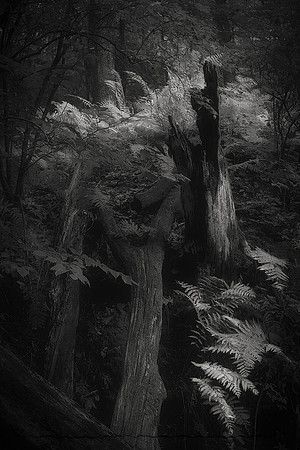
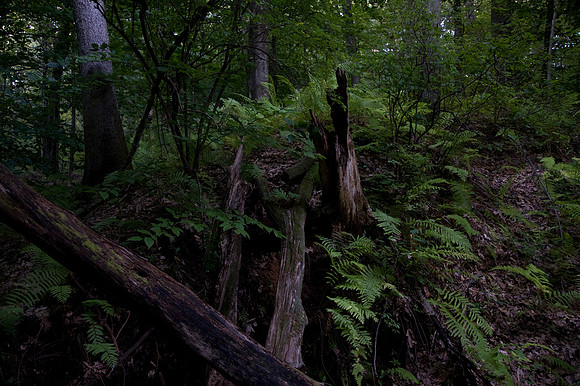
"Fallen" by Eric Rennie My photograph above is among 24 images selected for a juried competition called Framed: Shadow and Light that opens today at the Black Box Gallery in Portland Oregon. The exhibit, which is curated by Todd J. Tubutis, associate director at the Sheldon Museum of Art in Lincoln, NB, runs from December 1, 2016 until December 20, 2016. The shot was taken several years ago on an expedition to photograph ferns in River Highlands State Park, which is conveniently located along the Connecticut River at the end of my street in Cromwell, CT. While following a meandering path along a creek bed, I encountered this fallen tree, one of many felled during an ice storm a few years earlier. As sometimes happens, I got stubbornly attached to this image and have entered it in a number of juried competitions in the last year or two -- unsuccessfully until now. I feel that my persistence has been vindicated. The master photographer Ansel Adams once said, "The negative is comparable to the composer's score and the print to its performance." I don't work with film, so there is no negative in this case. But the principle remains the same. The original RAW image captured by my Canon 5D digital SLR camera may be seen below. You will notice I made a vertical out of a horizontal shot, cropping tightly around the fallen tree to remove most of the trunk veering off to the side in the lower lefthand corner. The image works both in color and in black and white. However, given the theme of the exhibit, I wanted to emphasize the delicate interplay of light and shadow, so I eliminated the color. Using Photoshop and various add-ons, I spent considerable time bringing out certain highlights and modulating the shadows. It's painstaking work, even if you don't have to do it in a darkroom!
I Am a Camera
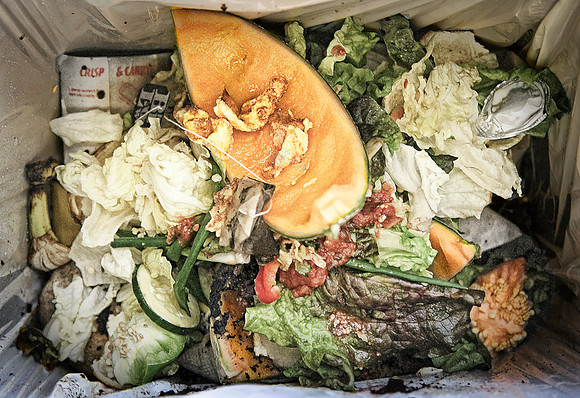
"Garbage Bin" by Eric Rennie I am a camera with its shutter open, quite passive, recording, not thinking. — Christopher Isherwood, Goodbye to Berlin Kenneth Thomas, my 11th-grade English teacher, gave us the assignment of writing a descriptive paragraph that was strictly factual, without any judgmental language or emotional shadings. This proved to be surprisingly difficult to do. You were almost reduced to making lists, shorn of any descriptive modifiers. For example, I might list the contents of the garbage bin in my kitchen thus: an aluminum lid to a yogurt container, a cardboard holder for a frozen sandwich wrap, a used tea bag, several green onion stalks, a wet paper towel, a banana peel, a wedge of green pepper, a smaller piece of red pepper, several pieces of iceberg and red leaf lettuce, a cucumber slice, a sprinkling of wet coffee grounds and a cantaloupe rind on top, with another partly submerged next to it. Apart from a few references to colors, there is no appeal here to the senses, which in this case is just as well, since the fragrance was none too appetizing. Even to refer to the container as a garbage bin may have introduced a pejorative connotation that is not in keeping with the intent of the exercise. By stripping the flesh off the bones of our writing, we were given some insight into how easily it can become larded with implicit judgments and emotional content. I no longer remember whether my class was reading Hemingway at the time, but I seem to recall A Farewell to Arms was assigned that year. Hemingway, of course, was noted for his unadorned style, which rigorously avoided both adjectives and abstractions – to say nothing of commas and subordinate clauses -- and left much unsaid altogether. Critics often point to his formative experience as a cub reporter for the Kansas City Star and later as a foreign correspondent for the Toronto Star in Paris, where he learned to say a great deal in as few words as possible when filing copy by transatlantic cable. Hemingway also drew inspiration from painters like Cezanne, as he told Lillian Ross in a famous profile in the New Yorker: “I was learning something from the painting of Cézanne that made writing simple true sentences far from enough to make the stories have the dimensions that I was trying to put in them.” Critic Zoe Trodd saw in Hemingway’s work a “camera-eye aesthetic” that captured scenes in a series of quick snapshots that were layered on to give an almost cinematic effect. Whether writing by the eye or the ear, Hemingway’s quest was always to write one true sentence. “Write the truest sentence you know," he would tell himself to get started. “So finally I would write one true sentence, and then go on from there.” Given his abhorrence of abstraction, his sentences were always aimed at the particular rather than at some great universal truth. They pointed beyond the words to the thing itself, exactly as a camera would. A camera never records more or less than what it is actually there. It offers no judgments, whether the subject is a bed of roses or a pile of garbage. It is the perfect instrument for what Buddhist’s call “clear seeing” – nonconceptual awareness unclouded by thought or emotion. Of course, a camera does not take its own pictures, any more than a story writes itself. What is the photographer’s role in manipulating an instrument that sees all? Most fundamentally, the photographer must decide where to point the camera and when to take the picture. There are adjustments to be made in focus, shutter speed and depth of field. For an experienced photographer, these adjustments are made almost reflexively. “Thinking should be done beforehand and afterwards—never while actually taking a photograph,” as the iconic photojournalist Henri Cartier-Bresson once put it. Cartier-Bresson famously said that he regarded his camera as an extension of his eye. But you can also think of it the other way around: that the photographer’s eye is an extension of the camera. If you learn to see as the camera sees, the world is stripped bare and you see it as if for the first time. The photographer’s job then is not so much to capture what he thinks he sees as what he has been shown. Making Strange
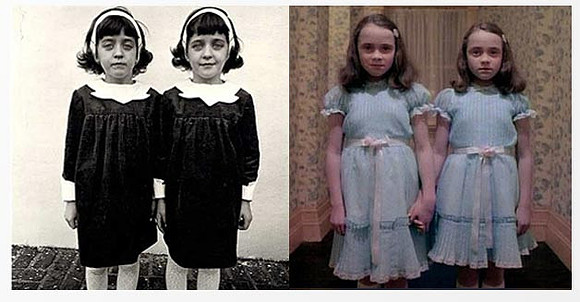
* * * My senior year at Yale, I was up late one night with a friend, and we got hungry. We remembered there was an all-night dinner on Chapel Street near the YMCA, only a few blocks from our residential college. We expected to find the diner nearly empty at that hour, but it was hopping. I remember feeling as if we had wandered onto the set of a Fellini movie. The place was crawling with pimps, prostitutes, drag queens and outliers of every sort who could get out of the cold for the price of a cup of coffee. Their pallor under the diner’s florescent glare indicated that they were mostly creatures of the night. My memory may be faulty after nearly half a century, but I seem to recall that conversation came to a stop when my friend and I walked in and took a seat at the counter. Here we were, a couple of college boys, a bit scruffy perhaps but otherwise unremarkable. And yet the stares from our fellow patrons strongly suggested they didn’t feel we belonged there. It was a freak show all right; but at that hour, in that company, we were the freaks. I don’t know if the photographer Diane Arbus ever took pictures at an all-night diner, but she was certainly drawn to the slice of humanity you might find at such places in the dead of night. Arbus staked out carnival sideshows, nudist camps, insane asylums and drag queen balls, always on the lookout for suitable subjects. Even her portraits of less exotic types display the same instinct for the uncanny, if not the downright grotesque. Freud, in his essay “The Uncanny,” notes that the term conveys both familiarity and strangeness, as do the subjects of Arbus’ portraits. They are fellow human beings whose gaze meets our own, suggesting they are not as different from us as perhaps we would wish them to be. Like the deformed carnival sideshow performers in Tod Browning’s notorious 1932 horror film Freaks, they welcome us into their world chanting, “One of us! One of us!” A young Susan Sontag was clearly unnerved by Arbus’ photographs in the first major exhibition of her work at the Museum of Modern Art in New York in 1972. In an essay in the New York Review of Books, Sontag contrasted them unfavorably with the Walt Whitmanesque celebration of the common man she had found in the work of the Depression-era photographer Walker Evans. She wrote that “the Arbus show lines up assorted monsters and border-line cases—most of them ugly; wearing grotesque or unflattering clothes; in dismal or barren surroundings—who have paused to pose and, often, to gaze frankly, confidentially at the viewer.” Sontag complained that “Arbus’s work does not invite viewers to identify with the pariahs and miserable-looking people she photographed.” But I suspect the real problem was quite the opposite. It was the confidential gaze, rather than just the grotesqueness, that she found so unsettling. Arbus’ portraits eliminated any distance between viewer and subject, leaving us defenseless against our common humanity. To gain insight into Arbus’ method, we might consider a concept known as ostranenie, first coined by the Russian literary critic Victor Shklovsky a century ago. Variously translated as “defamiliarization” or “estrangement,” this artistic technique literally means “making strange.” The idea is to take something that has become shopworn or overly familiar and to present it in such a way that we are forced to see it as if we had never encountered it before. It is one thing, of course, to find humanity in those who are regarded as freaks, and quite another to bring out the strangeness in those who might otherwise appear to be quite ordinary. Arbus was able to do both. If you are looking for evidence of the uncanny, there is no need to stake out carnival sideshows or all-night diners. Just drop by the nearest Wal-Mart or any other venue where a cross-section of the population is likely to be found. Here you will find a fair sampling of everything Sontag found objectionable in Arbus’ work -- the lame, the halt and the blind -- right down to their unflattering clothing. Normally we can go about our business without having to engage them intimately, as you do in an Arbus photograph. As long as they remain anonymous, we are fine. It is not their strangeness so much as their familiarity that we find hard to bear. We want no reminders that they are one of us. Haunted
"Cotton Hollow" by Eric Rennie My photograph, "Cotton Hollow," is one of 51 selected (out of 577 submissions) for a group show at the Darkroom Gallery in Essex Junction, VT. The exhibition runs from October 13, 2016 to November 6, 2016, The juror is Russell Joslin, a photographer, editor and publisher of Shots magazine. The picture of a 200-year-old cotton mill was taken last fall at the Cotton Hollow Preserve along Roaring Brook in Glastonbury, CT. The image was previously exhibited at the Southest Center for Photography in Greenville, SC and at the A Smith Gallery in Johnson City, TX. Darwin's Peacock
|