Still Life
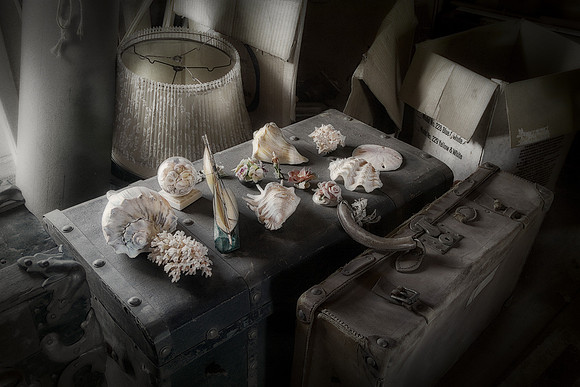
"Attic Treasures" by Eric Rennie A still life is normally thought of as a work of art depicting inanimate objects that are carefully arranged and lighted in a studio for pleasing aesthetic effect. I am not a studio photographer, and I tend to shoot things as I find them. Consequently, my still lifes are more “found objects” rather than something artfully premeditated. For me, the process is always a bit of a mystery. I have a strong sense that my photographs, no matter what the subject matter, are not just what I have seen but what I have been shown. My photograph "Attic Treasures" is one of 36 works of art selected by a panel of jurors for an all-media exhibtion called Still Life: Past, Present and Future at the UBE Gallery in Berkeley, CA. The show runs from September 9, 2016 to October 29, 2016. I shot the scene as I found it in the attic of a century-old farmhouse in Blackstone, MA that my aunt had been living in. A black-and-white version had been exhibited last year at a juried competition at the A Smith Gallery in Johnson City, TX (where it was awarded an honorable mention) and at the Peter Miller Fine Arts Gallery in Providence, RI. A Sense of Place
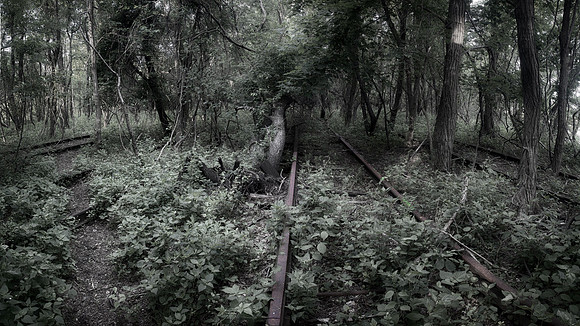
"Tracks to Nowhere" by Eric Rennie My photograph entitled "Tracks to Nowhere" is one of 35 images selected for a juried competition entitled "A Sense of Place" at the PhotoPlace gallery in Middlebury, Vermont. Curated by photographer Jane Fulton Alt, the exhibit runs from September 7 - September 30, 2016. The image was taken in a wooded area along the Quinnipiac River in North Haven, Connecticut that had once been a railroad yard extending more than seven miles from North Haven to New Haven. All that remains now are a few rusted rail lines and switch boxes. A second image, "Tickets," was selected for an online gallery in conjunction with the exhibit. The Mother of Beauty
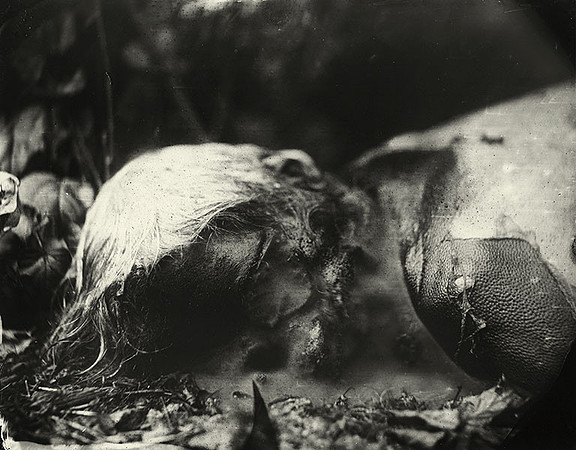
Photographer Sally Mann first came to prominence a generation ago with images of her three semi-feral children playing naked on their remote family farm in the Blue Ridge Mountains of Virginia. Her work created a sensation, although not in a way she would have anticipated. She was denounced in some quarters as a child pornographer, even though the images were no more pornographic than the naked cherubim decorating Renaissance religious paintings. The controversy mostly demonstrated that innocence, like beauty, is in the eye of the beholder. More recently, Mann has courted controversy of a different sort by photographing rotting corpses at the University of Tennessee Anthropological Research Facility’s “body farm” in Knoxville, Tennessee. Surrounded by a razor-wire fence, the 2.5-acre wooded facility is used to study the effects of decomposition on some 40 cadavers that have been left exposed to the elements for extended periods of time. The research findings help pinpoint a time of death and other circumstances of interest to criminal investigators, based on such factors as body bloating, marbling and slippage of skin, as well as the actions of insects and scavenging animals. These phenomena are not for the squeamish. Mann claimed to be unaffected by the sights and smells she encountered at the body farm, which she photographed on assignment for the New York Times. The account she gave in her memoir, Hold Still, is noteworthy for its almost clinical detachment: Pausing by a body and waiting until the rustling of leaves quieted, I could hear the maggots noisily eating, a sound sometimes like the crackling of Rice Krispies in milk and other times, like raw hamburger being formed by hand into patties. The bulging skin roiled with their movements beneath it. In one instance recorded at the body farm, the industrious maggots reduced a man by forty pounds in just twenty-four hours, expanding themselves from the size (forgive the culinary comparison) of uncooked grains of rice to a plump macaroni. Death is not pretty, although you would never know it from the rituals normally surrounding it. We do our best to prettify corpses, dressing them up in their best suit of clothes and subjecting them to the embalmer’s art before they are laid to rest in silk-upholstered mahogany splendor. Human beings have been burying their dead for at least 100,000 years. Although there are no written records going back that far, we can safely assume the custom arose to spare loved ones the sights and smells that Mann encountered at the body farm. Embalming and mummification have long been practiced to counter the effects of putrefaction. Through much of the 19th century, the recently departed were memorialized in post-mortem photographs, many of infants or small children captured in life-like poses in a crib or cradled in their mothers’ arms. The images might be hand-tinted to put a blush on pallid checks or otherwise retouched to open eyes that were closed in death. Memorial photographs are now regarded as a morbid preoccupation of our Victorian ancestors; indeed, actual depictions of dead bodies in any setting these days are, for the most part, scrupulously avoided. British sociologist Geoffrey Gorer argues in his essay, “The Pornography of Death,” that we have merely replaced the Victorian squeamishness about sex with a modern-day taboo against death. However inadvertently, Mann already had experience transgressing taboos when she undertook the assignment from the New York Times to photograph the body farm. But notwithstanding the subject matter, there is nothing lurid about her treatment of the dead. She uses an antique bellows view camera and an even older wet-plate collodion process on glass negatives that gives a dark, primordial look to her images. When seen through her lens, the bodies are merely another feature of the landscape in which she finds them -- and their decay just another fact of nature. And if we do not avert our gaze, we discover that death is not an end but a transformation in which the earth gradually reclaims its own. Whatever the final destination of the soul, our mortal remains remain. We find ourselves back in the place where, according to our founding myths, we were formed from the dust of the ground. As God tells Adam, whose name is a play on the Hebrew word for earth, “for dust you are and to dust you will return.” To Stand and Not to Pass
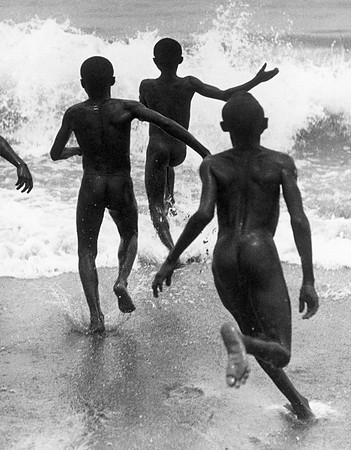
"Three Boys at Lake Tanganyika" (c. 1930) by Martin Munkacsi The photograph that launched Henri Cartier-Bresson’s iconic career was not one he took himself. As a footloose art student returning home to his native Marseilles in 1931 from a sojourn in Africa’s Ivory Coast, he first saw what he later described as “the only photograph to have influenced me.” Published in a French arts magazine, the image by Hungarian photographer Martin Munkacsi showed three naked boys frolicking in the surf at Lake Tanganyika. The boys were seen from behind running toward the water, their dark bodies as sleek as seals, silhouetted against white waves breaking against the shore. “When I saw the photograph of Munkacsi of the black kids running in the wave I couldn't believe such a thing could be caught with the camera,” Cartier-Bresson said later. "He made me suddenly realize that photographs could reach eternity through the moment." The following year Cartier-Bresson bought his first Leica 35mm camera with a 50mm lens, which he said became the “optical extension of my eye.” First sold in 1925, the Leica represented a significant technological advance over the bulky large- and medium-format cameras then in use. Compact and durable, the Leica was capable of shutter speeds of 1/500th of a second, which enabled photographers to capture a range of movement unheard of with older cameras. The Leica quickly became the camera of choice for a new generation of photographers that included Walker Evans, Robert Capa, André Kertész, Robert Frank, Garry Winogrand and Lee Friedlander. The contradiction inherent in all photographs is that they make still images of a world in motion. Initially, this was possible only by bringing the world to a standstill, because shutter speeds were too slow to capture movement. This is why early 19th-century photographs were always posed, and human subjects often appeared as if rigor mortis had set in. Shutter speeds had improved by the late 19th century, but cameras were still too bulky to allow photographers to immerse themselves fully in the flow of life. The Leica now made it possible for photographers to do their work without people playing to the camera. Cartier-Bresson went a step further by covering the chrome parts of his camera with black tape to make it as unobtrusive as possible. Cartier-Bresson’s reaction to the photograph that launched his career may seem puzzling at first. How do you reach eternity through the moment? A moment, which by definition has no duration, would appear to be on the other end of the scale from eternity, which is unending. We normally think of a moment being something like a movie still, which follows the moment before and precedes the moment after. A photograph can be thought of the same way, like a moment trapped in amber. You look at Munkacsi’s image of the three boys playing by the water’s edge at Lake Tanganyika, and you wonder what became of them. They could not have been more than 14 or 15 years old when the picture was taken in 1930, a lifetime ago. Munkacsi, who was 34 when he shot it, later emigrated to New York and became a high-end fashion photographer for Harper’s Bazaar. He died in 1963 at age 67. Moment succeeds moment, inexorably – and we can never quite lay hold of any of them. Perhaps St. Augustine can set us straight on the matter of eternity. Augustine wondered in his Confessions what happened before God created the heavens and the earth. He reasoned that there was no “before,” because God abided in eternity, “which stands and does not pass, which has in itself no past or future.” The subjects of Munkacsi’s photograph obviously had a past and a future, as did the photographer himself. Yes, the image depicts a moment in time, but it is also lifted out of time, transformed by Munkacsi’s artistry. The boys run toward the water, their feet kicking up spray in the wet sand, their bodies glistening in the sun. They may have lived out their lives in some particular time and place, but they are alive forever in this photograph, not frozen in time but timeless. This is what Cartier-Bresson saw in Munkacsi’s photograph, a moment that stands but does not pass, a window into eternity. Land
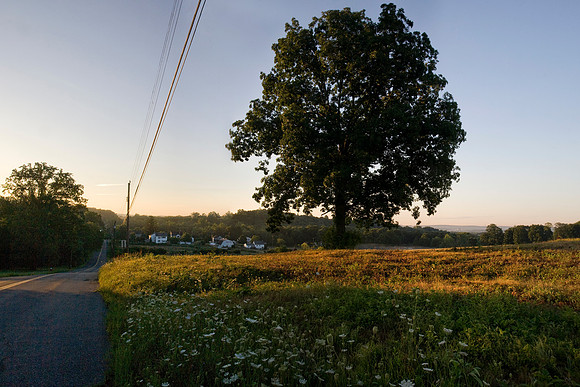
"Hoffman Farm" by Eric Rennie You would think from the photograph above that the small New England town in which I live is pretty bucolic. But apart from a few active nurseries here and there, the community these days is mostly given over to suburban housing developments. Hoffman Farm was purchased by the town some years ago to preserve open space. The farm now features a community garden and a dog park. The photograph is one of 25 appearing in a juried competition called "Land" at the Midwest Center for Photography in Wichita, KS. Curated by gallery drector Linda Robinson, the exhibition runs from July 29, 2016 to Augist 12, 2016. |