The Observer Effect
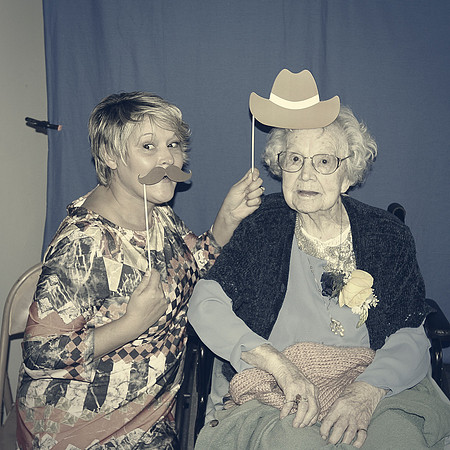
"Aunt Mildred's 106th Birthday Party" by Eric Rennie If you want to make someone feel self-conscious, just point a camera at him. That, in a nutshell, is the dilemma facing every photographer who wants to capture subjects in their natural state. There are certainly portrait photographers who are skilled in putting their subjects at ease, just as there are actors and models who are skilled at appearing at ease in front of a camera. But, of course, they are just good at pretending. Most people reflexively put on a “camera face” whenever a camera is pointed in their direction, a faintly pained expression that passes for a grin in photographs. The only way for a photographer to get around “camera face” is to distract the subject or otherwise to shoot before the subject realizes a camera has been pointed in his or her direction. The dilemma facing photographers who try to shoot subjects in their natural state is known to quantum physicists as the “observer effect.” Quantum physics is the study of subatomic particles, which operate according to a completely different set of laws than objects in the macroscopic world that we can see. For one thing, subatomic particles sometimes behave like particles and sometimes like waves, depending on whether or not they are observed. In a classic double-slit experiment, you can shine light on a barrier with two slits that allow the light to pass through to a photographic plate on the other side. If you position photon detectors beside each slit, the light will behave like photon particles, passing through one slit or the other and leaving two parallel lines on the photographic plate on the other side. But if the photon detectors are absent, the light will pass through both slits simultaneously and leave a striped pattern on the other side characteristic of a wave. It is as if the light had put on its own “camera face” when the photon detectors were in place and had decided to appear as particles. According to quantum theory, subatomic particles exist in an indeterminate state until they are observed. In the “clockwork” universe described by Isaac Newton in the 18th century, objects exist independently of an observer; not so in the quantum realm. As Nobel-Prize-winning physicist Erwin Schrödinger expressed it: “Subject and object are only one.” The late John Wheeler, the physicist who coined the term “black holes,” believed the same may be true of the macroscopic world as well. He theorized that we live in a “participatory universe” in which consciousness is not a bystander to physical reality but is an essential element in its formation. In a sense, you could say the world comes into being because we are here to witness it. As a landscape photographer, I am not usually confronted with “camera face” when I point my camera. Looking through the lens, I find it easy to objectify my subject matter if I so choose. And yet I have a growing sense that what I see though my lens is what I am being shown. Not that there is anyone tapping me on the shoulder and telling me where to point the camera. It’s more that the act of seeing and the fact of being seen are one and the same. There is no longer a sense that the photographer stands apart from what is perceived. As William Butler Yeats wrote in the final line of his poem, “Among School Children,” “How do we know the dancer from the dance?” Snow & Ice in L.A.
"Iced Over" by Eric Rennie SNOW & ICE IN L.A. -- My photograph "Iced Over," taken soon after sunrise several years ago along the Mattabesset River in Connecticut, is on display this month in a juried competition at the 1650 Gallery in Los Angeles. Fog
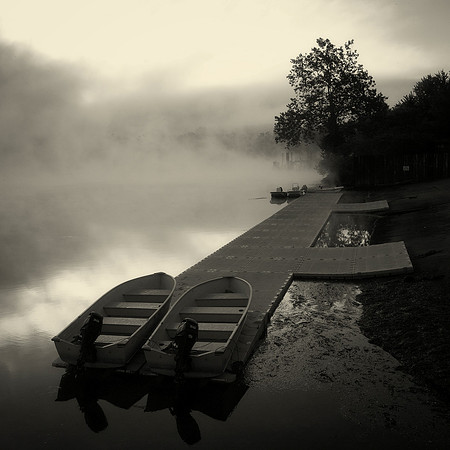
My photograph entitled "Two Boats on a Foggy Morning" is one of 35 images selected by curator Del Zogg for a juried competition opening this Friday at the Southeast Center for Photography in Greenville, SC. The exhibit runs from January 6, 2017 through January 31, 2017. As a landscape photographer, I love shooting in the fog, but it can be tricky. The light is softer, more diffuse. Color saturation is reduced, and contrasts are muted. Even a high-end digital camera does not come equipped with radar, so it may be difficult to get a good read on featureless terrain. The camera’s auto focus may not function properly, and the light meter won’t do much better. I live near a river, so I get plenty of practice working in foggy conditions, especially at times of year when there are sharp swings between day and nighttime temperatures. I especially like to be out at first light, when the sun has not yet burned off the fog or mist. But you have to be quick about it, because conditions can change rapidly. Either you suddenly find yourself in brilliant sunshine, or the fog really rolls in, and you might as well be shooting a blank wall. For all the technical challenges, photographers know fog can transform an otherwise dreary landscape into something wondrous. Likewise, film directors can use fog to strike a mood, whether ethereal or menacing. There was a reason why the makers of Casablanca brought out the fog machines for the movie’s final scenes, with Humphrey Bogart and Ingrid Bergman making their tearful farewells. This was followed by Bogart and Claude Raines walking off together into the night after the evil Nazi major was shot dead. To swelling strains of "The Marseillaise," they disappear into the fog as Bogart utters that immortal line, “Louie, I think this is the beginning of a beautiful friendship.” “One does not see anything until one sees its beauty,” Oscar Wilde once wrote. “Then, and then only, does it come into existence. At present, people see fogs, not because there are fogs, but because poets and painters have taught them the mysterious loveliness of such effects.” No doubt Wilde can be accused of overstating his case; it would not be the first time. And yet there is an argument to be made here. A photographer points his camera at something that is plainly visible to everyone and hopes by putting a frame around it to make people see. This essentially is the aim of every artist. But how far can one carry the argument? “Things are because we see them,” Wilde insisted, “and what we see, and how we see it, depends on the Arts that have influenced us.” Take his first proposition: that things are because we see them. Philosophers may recognize a restatement of Bishop Berkeley’s famous dictum, esse est percipi, usually translated as, “to be is to be perceived.” In effect, he is telling us that things exist because we perceive them. Berkeley’s contention has been the subject of fierce debate – not to mention ridicule --- since it was first proposed in the 18th century. Then along came quantum physicists in the early 20th century and effectively sided with the Irish prelate. According to the Copenhagen interpretation of quantum mechanics, which governs the subatomic realm, elementary particles remain in an indeterminate state – wave or particle? -- until they are observed. In other words, to be is to be perceived. Einstein, among others, was greatly disturbed by the implications of quantum mechanics, which he had helped to usher into the scientific mainstream. In effect, the world did not exist independently of an observer. All this may seem far removed from the concerns of a photographer who goes out to take pictures early on a foggy morning. And yet Wilde had made grand pronouncements about the role of the artist in mediating our sense of the world. “Nature, no less than Life, is an imitation of Art,” he proclaimed. He continued in this vein: “Nature is no great mother who has borne us. She is our creation. It is in our brain that she quickens to life.” Of course, when the quantum physicists speak of observation being required for matter to assume a particular state, they are talking about scientific measurement of elementary particles. As far as I know, there has been little discussion of its application to landscape photography. And yet there is certainly a sense in which the world – or at least one version of it – does not exist until its features are first distilled from the morning fog and you snap its picture.
The Ordinary Made Extraordinary
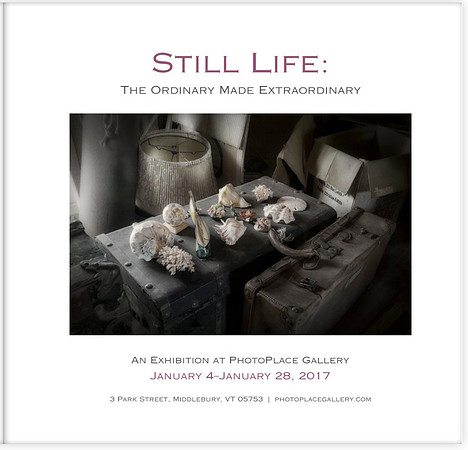
My photo "Attic Treasures" is one of 35 images selected by photographer Kate Breakey for a juried competition at the Photoplace Gallery in Middlebury, VT. The exhibition runs from January 4, 2017 through January 28, 2017. The picture was taken several years ago in an old New England farmhouse where my Aunt Mldred lived until she was over 100. The version abov is from the title page of the exhibit catalogue. In Stillness
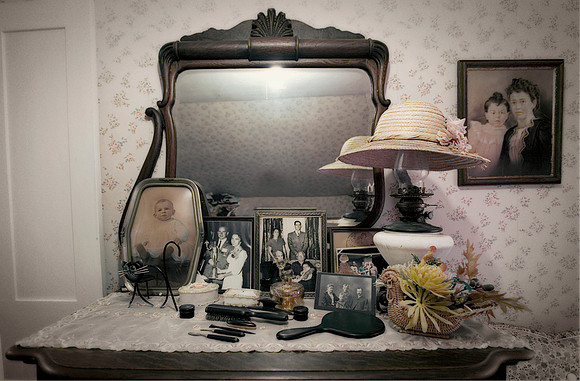
"Aunt Mildred's Bureau" by Eric Rennie Still lifes are a common theme in juried competitions, including an exhibition called "In Stillness" that runs from December 8, 2016 to January 1, 2017 at the Darkroom Gallery in Essex Junction, VT, outside Burlington. My work above is one of 54 photographs selected for the show by photographer Diane Gabriel. As I noted in a previous post, a still life is normally thought of as a work of art depicting inanimate objects that are carefully arranged and lighted in a studio for pleasing aesthetic effect. I tend to shoot things as I find them, including this image taken at the little New England farm house where my father grew up and where my aunt lived until she was over 100. The photos on the dresser are of various of my relatives, including the one at left that I believe is of my father as a baby. |