Small Wonders
Two of my photographs are part of a group show sponsored by the Maryland Federation of Art entitled "Small Wonders" at the Circle Gallery in Annapolis, MD. The exhibit, which runs from November 30, 2013 to December 29, 2013, features artwork of 11" or less on any one side. Both of my images were taken on the spur of the moment. The first, called "Glassware," shows light shining through rows of inverted wine glasses lined up on shelves at a restaurant where my wife and I stopped to eat on a trip some years ago to the Gaspé Peninsula in Quebec. This image was awarded an "Honorable Mention" by the show's juror, Linda Crocker Simmons, curator emerita of the Corcoran Gallery of Art in Washington, DC. The other image was taken recently after I cut into a cantalope and discovered it was not yet ripe. The melon was inedible but beautiful. I shot it close up in a bathtub with the lights out, holding a small LED flashlight overhead to cast the scene into sharp relief. I call the picture "Melon in Blue." Capturing the Moment
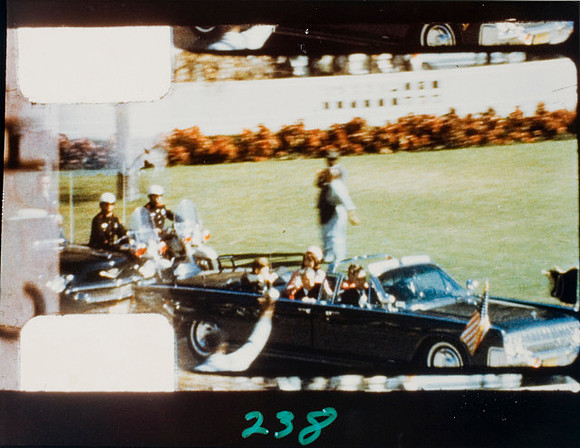
Serious photographers must always be aware of time if they are to succeed in capturing the moment. Getting the right exposure depends on setting the proper shutter speed, which is calibrated in seconds or fractions of a second. Photographing a moving subject in low light without a flash is difficult, because the slower shutter speeds required to get the right exposure will result in a blurry image. Even a stationary subject may require a tripod at longer exposures due to camera shake if the shutter speed is slower than about 1/30th of a second. The basic difficulty is that the camera only produces still images, while the world keeps moving. A still image is basically a fiction, as Susan Sontag noted in On Photography. “The photographed world stands in the same, essentially inaccurate relation to the real world as stills do to movies,” she wrote. “Life is not about significant details, illuminated a flash, fixed forever. Photographs are.” Her observation is nowhere better illustrated than with Abraham Zapruder’s 27-second film clip of the Kennedy assassination in 1963, taken with a home-movie camera and excerpted a week later in Life Magazine as a series of black-and-white stills. The sequence shows the president clutching his throat as the first bullet strikes him, then slumping over after the fatal shot to his head. Doubts about the Warren Commission’s finding that Lee Harvey Oswald was the lone gunman were exacerbated when the actual film was aired years later on television. Now it appeared that Kennedy’s head was flung violently backward and to the right at the moment the second bullet struck, suggesting the shot came from the front, not from Oswald’s perch in the Texas School Book Depository behind the president’s limousine. Which is the true depiction of events? The controversy still rages a half century after Kennedy’s death. One might well conclude that a movie camera does a better job of capturing a world in motion, but the result is ultimately no less an illusion. The sequence of photographs published in Life Magazine a week after the Kennedy assassination was, in fact, a better representation of what was actually recorded by Zapuder’s Bell & Howell movie camera than the moving images shown on TV years later. Movement – or rather the illusion of movement – is created not by the camera but by the eye when a sequence of successive still images is threaded rapidly through a projector. Just as movies are a succession of still images, we regard time as a succession of those moments we try to capture in photographs. But what exactly is a moment? We think of it as a slice of time, but how big a slice? In photographic terms, the exposure cannot be so long that the image would be blurred. Moments are more like points on a line, which you might recall from geometry class have no physical dimensions in themselves. There can be an infinite number of points on a line, but the points will never add up to a line. Similarly, a moment has no duration in itself, and therefore an infinite number of moments in succession can never amount to any length of time. Not only is a still image a fiction, as Susan Sontag said, but so apparently is the moment the photographer is trying to capture. What then does that say about time?
City of Tiny Lights
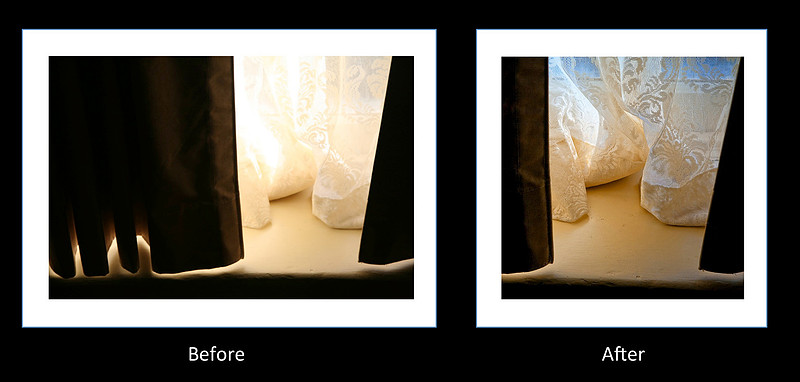
A photograph of mine entitled "Lace Curtains" is appearing in a juried competition called "City of Tiny Lights" at the SU Galleries at Salisbury University in Salisbury, Maryland. The show runs from November 15, 2013 to December 14, 2013. Artwork includes all traditional and non-traditional visual arts media but must be no larger than 12 inches on a side. For more on my entry, go here. Mind's Eye“You don't take a photograph, you make it,” Ansel Adams once wrote. Adams’ comment came at a time when serious practitioners still had to defend the legitimacy of photography as an artistic medium. They had to overcome the prejudice that photographers did little more than point their cameras at a nice piece of scenery and press the shutter. Even with Adams’ bulky large-format camera and glass-plate negatives, taking the picture was the easy part. He would then spend hours in the darkroom turning the raw image into a finished work of art. “The negative is the equivalent of the composer's score, and the print the performance,” Adams said. There are still those who think it is somehow cheating to manipulate an image after the picture is taken, which is easier than ever to do now that most photographers work with digital images on a computer rather than with film in a darkroom. People don’t realize that a camera doesn’t see the way the human eye does, and often the only way to make a photographic image look natural is to make adjustments after the image is captured. Adams, of course, was a consummate artist, and he was not content merely to present images as they might appear to the human eye. He used a technique he called “visualization” to try to imagine in his mind’s eye precisely how he wanted the finished photograph to appear even before he actually took the picture. He used this technique in an early black-and-white photograph of the massive granite edifice known as the Half Dome at Yosemite National Park. To heighten the dramatic contrast of sunlight and shadow on the 4,000-foot rock formation, he used a deep red filter to darken the sky. The sky looks almost black in the finished photograph, which you never see in broad daylight. And yet the image looks perfectly natural. Below I have displayed two versions of a photograph I took on my birthday several years ago in a hotel room in Annapolis, Maryland. On the left is the image as taken in late afternoon with a hand-held camera using available light. On the right is the same image after much careful adjustment on my computer using Photoshop and various add-ons. All the digital information presented in the finished photograph was present in the original image; however, I needed to do a bit of tweaking to bring it out. This is what Adams meant when he said you don’t take a photograph, you make it.
For a full-sized view of the final image, click here. Inside the Box
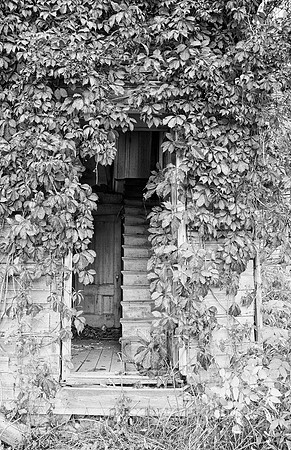
My wife and I were driving along a state highway near Caribou, Maine, some years ago when I spotted an abandoned house by the side of the road. I grabbed my camera, jumped out of the car and began taking pictures as my long-suffering wife waited for us to be on our way. I don’t know how long the house had stood empty, but the siding was worn down to bare wood, and the glass was gone from the windows. The roof was bashed in, and the structure was almost entirely covered in vines. I shot through the windows and the doorway, which opened into a darkened front hall and stairway. An image of the doorway overgrown with vines remained on my hard drive for several years until I came across it again and realized I might have something.
This image, suitably matted and framed, was recently exhibited in a juried competition at the Center for Fine Art Photography in Fort Collins, Colorado. The theme of the show was listed as “Box Squared,” with the following explanation: While life and nature are cyclical and cylindrical, we live in boxes, travel around in boxes and buy things in boxes. We talk about "out of the box," squaring up, and box stores. Explore the box and square within a cylindrical world.
While I might quibble with the notion that the natural world is primarily cylindrical, it is hard to dispute the show’s basic premise. In Conversations with Myself, the philosopher Alan Watts observed that the essential difference between humankind and nature is our penchant for putting things in boxes, not the least ourselves. More |