Small Wonder
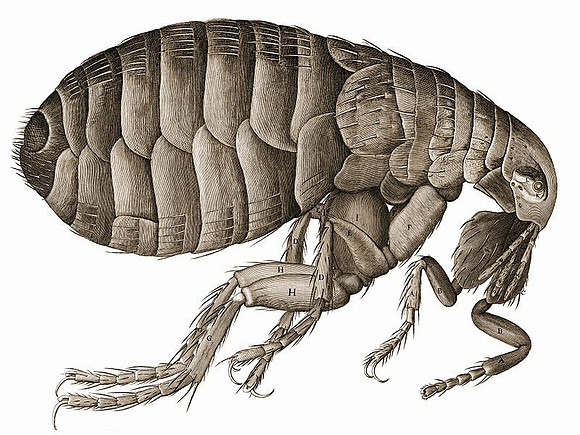
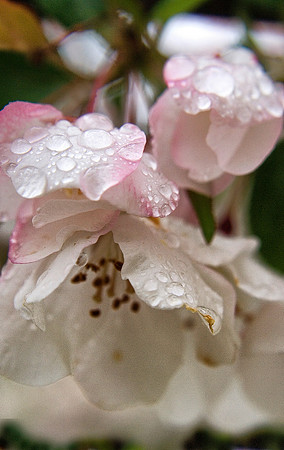
"Flea" in Robert Hooke's Micrographia In 1665, the year before the Great Fire in London, the polymath Robert Hooke published a scientific treatise that created a sensation. Entitled Micrographia, the work introduced readers to a whole new world that became visible through a new-fangled device called a microscope. Hook’s discoveries were accompanied by his own exquisitely detailed – and expertly rendered -- copperplate engravings of objects too small to be seen with the naked eye: the cellular structure of cork, a monstrous hairy-legged flea, an ant enlarged enough to send picnickers fleeing in terror. “By the help of microscopes,” Hooke proclaimed, “there is nothing so small, as to escape our inquiry; hence there is a new visible world discovered to the understanding.” He went on to say that “we now behold almost as great a variety of Creatures, as we were able before to reckon up in the Whole Universe itself.” Like most other sighted creatures, human beings are engineered to see clearly enough at close range to catch their prey and far enough to spot predators before they themselves become prey. The invention of lens-based magnification devices in the sixteenth century vastly increased their ability to see in either direction. Telescopes opened up the heavens, but initially they did not so much alter our understanding of the stars as add vastly to the number that were now visible. Microscopes, by contrast, opened up a universe of small things that had existed undetected until then. Hooke’s contemporary Anton van Leeuwenhoek, a Dutch draper and amateur scientist, perfected the compound microscope and discovered the existence of bacteria, blood corpuscles in capillaries and the teeming life in a drop of water. Cameras are lens-based devices that mostly work at middle distances. But they can also be outfitted with telescopic lenses to shoot distant objects or be attached to microscopes to capture the sorts of things Hooke was only able to record on copper plates. I rarely use telephoto lenses for my landscape work, for the most part only when physically prevented from getting as close to my subject as I might otherwise wish. On the other hand, I sometimes like to use macro extension tubes to focus more closely on a subject and with greater magnification than would be possible with a lens alone. This spring, for example, I screwed macro extension tubes onto my lens to photograph dramatic closeups of the pink and white blossoms on the crabapple trees in my front yard. A delicate litle flower no larger than a quarter now filled the entire frame of an image taken just a few inches from ts subject, and it was no longer possible to ignore its demure splendor. What is most striking about the world as seen in extreme closeup is the attention to detail. Hooke’s iconic flea, blown up to the size of a gatefold illustration in Micrographia, is revealed to be a kind of armadillo on stilts, its body, legs and snout bristling with whiskers, each one carefully rendered. How many hours did Hooke spend hunched over his microscope, painstakingly recording by hand everything he had seen? And who originally lavished such detail on a creature smaller than a grain of rice? If you examined one of my digital photographs under a microscope, you would find it be nothing more than a pattern of dots. But if you examined any of God’s smallest creatures under a microscope, you would find it fully formed down to the last detail. If you examined a microcrobe in the intestinal tract of a flea using an electron microscope, there would still be no stinting on detail. So if you were looking here for evidence of God’s handiwork in creation, what might you find? You could only conclude that God is indeed in the details. Kindred
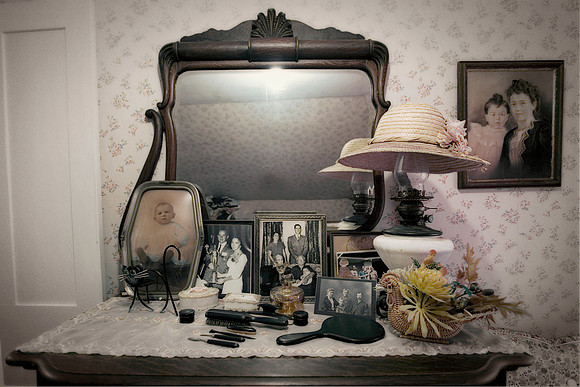
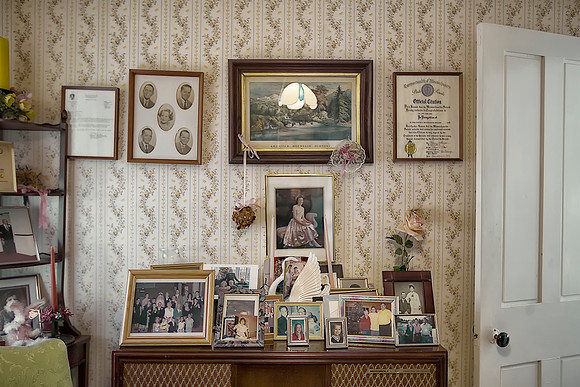
My grandfather’s dairy farm was in many ways like on old photograph, seemingly frozen in place as the world moved on. Stepping through the door of the little New England farmhouse that my Aunt Mildred continued to occupy until very recently was like stepping back in time. The interior looked much as it did when I first laid eyes on it over 50 years ago – and probably much as it did when my father grew up there during the Depression. It wasn’t just the antique furniture or the floral-patterned wallpaper or the lace curtains. The house itself had never really been remodeled, only added onto. My grandfather had bought the place in 1910, and the oldest parts of the house dated from 1840. Taking pictures in the farmhouse, I often found myself photographing other photographs. Almost every flat surface in the front parlor, sitting room and bedrooms was occupied by family photographs, dozens and dozens of them. Aunt Mildred pointed with pride to a black-and-white portrait of her father, a Rhode Island state senator, from the turn of the last century. There were numerous portraits from the same period or older: various ancestors, stiff and unsmiling, in ornate oval frames. There were many later portraits and snapshots -- black and white or color according to their vintage -- of children, grandchildren, great-grandchildren, nieces and nephews. There were wedding pictures and group shots of relatives in their Sunday finery. By the time I began taking pictures of the farm, the young farmer and his wife who bought the place more than a century ago—they and their descendants after them—were long gone. Of all those who ever lived there, the only one who remained was Aunt Mildred, and now she, too, is gone. The are only perishable memories and pictures, including photographs of photographs bearing mute testimony to those who had gone before. This photographic record can never truly make the world stand still. But it will have served its purpose if it can convey something of what once was and what is now gone forever. Scenic Overlook
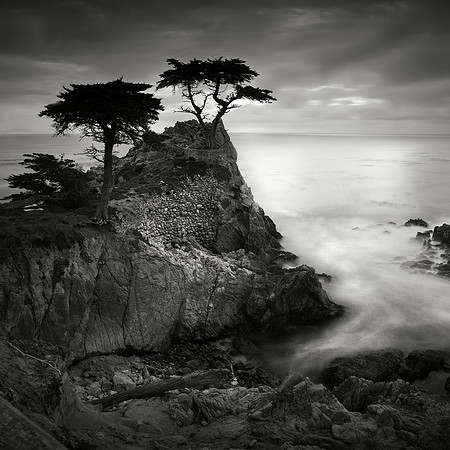
Lone Cypress Tree, Pebble Beach, California On a trip to northern California some years ago, my wife and I took a spin along 17-Mile Drive south of Monterey, stopping for a look at the Lone Cypress perched atop a jagged outcropping of granite along the Pacific coastline. This venerable tree, which has survived the vicissitudes of wind and waves for more than 250 years – as well as an arson attack in 1984 – is now held in place with steel cables. Although I did not bring my camera along on this expedition, I noticed a sign at the top of the overlook that read: “Photographs or art renderings of the Lone Cypress for commercial or promotional purposes cannot be taken or created without written permission from Pebble Beach Company.” Really? I knew that a silhouette of the tree was used as the company logo at the nearby Pebble Beach resorts, but this was the first time I had ever heard of anyone claiming trademark protection for a living tree. It was true that the granite outcropping on which the tree perched was owned by the Pebble Beach Company; indeed, the entire length of 17-Mile Drive was a private toll road belonging to the Pebble Beach Company. Still, intellectual property attorneys not affiliated with the company are doubtful the courts would go along with its claim that its trademark protection extends to the actual tree. Although the company has been zealous in defending its trademark, it has never actually had to file a lawsuit for trademark infringement. Few artists or photographers have the resources to take on such a big company; in fact, none has to date. Whatever the merits of the Pebble Beach Company’s position, the Lone Cypress holds a lesson for any serious photographer. It is this: If the thing you want to shoot is so familiar that someone has slapped a trademark on it, you should probably point your camera elsewhere. Trademark protection or not, there are subjects so familiar that they are better suited to a postcard than to a work of art. Even if you present a well-worn subject with consummate skill in a new light or from a better angle, you must still overcome the viewer’s sense that he or she has seen it all before. This is not to say you can’t take your shot anyway, only that you have a lot to overcome. As a general rule, it is probably best to avoid the scenic overlook where you must elbow your way through the crowd to get a clear shot. Having said that, I do not think the pursuit of novelty for its own sake will necessarily yield much beyond novelty for its own sake. I am struck by something Arthur Schopenhauer said: "The task is not so much to see what no one yet has seen, but to think what nobody yet has thought about that which everybody sees." Schopenhauer was a philosopher, not a photographer, and he was speaking about truth, not a work of art. Yet I believe the same principle applies. If the photographer can take what has been staring you in the face all along and make you see it as if for the first time, then he has done his job. Country Lane
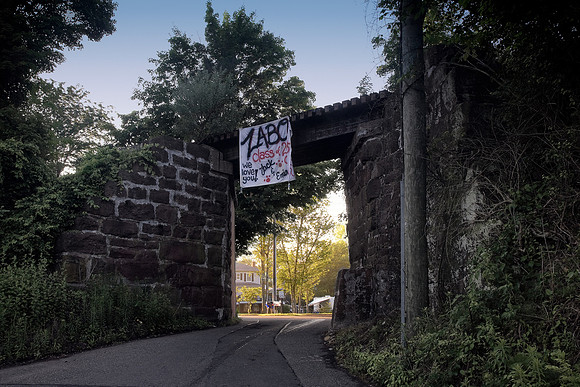
"Nooks Hill Road Underpass at Dawn" by Eric Rennie Years ago I set myself the task of photographing whatever I could find within walking distance of my house in Cromwell, CT, a small New England river town. This image is part of a series on Nooks Hill Road, which runs from the Holy Apostles Seminary east for about one-and-a-half miles to the Connecticut River. Travel its length and you will see much of it was developed before modern zoning laws. Homes, factories, farms and a riding stable have all grown up side by side. The two-lane road narrows at one point to a single lane to squeeze through an old stone railroad trestle. The town’s taxpayers defeated a voter referendum some years ago that would have widened the underpass to two lanes – so much the better for my picture taking. This photograph is on display at the 82nd Annual National Art Exhibition at the Cooperstown Art Association Gallery in Cooperstown, NY. The exhibit runs from July 14, 2017 until August 18, 2017. The juror was artist Larry Brown.
In Focus
I was rinsing out a glass mixing bowl in the kitchen sink one Saturday morning as sunshine streamed through an east-facing window. The mixing bowl had contained the egg batter I used to make French toast. As water from the tap swirled around in the bowl, tiny bubbles formed on the surface of the yellowish liquid, gleaming like translucent pearls in the morning light. Such exquisite beauty, and so unexpected! I stood momentarily transfixed at the sink, like a gallery patron contemplating a work of art. But the moment passed, the bubbles dissipated, and the bowl was soon rinsed out, ready for the dishwasher. It was a moment as small as the bubbles swirling around in the mixing bowl and might easily have escaped my notice altogether had my mind been elsewhere. |