Murder Scene
It's not often you come across a photograph of your great-grandfather face down in the dirt with a bullet in the back of his head. It was taken by Edgar Mearns, a U.S. Army surgeon posted at Camp Verde in Arizona. He happened upon this scene soon after my great-grandfather, Andres Moreno, was gunned down by a lawyer named Knox Lee, who had been a passenger on the freight wagon Moreno was driving from Globe to Flagstaff in 1887. The two had quarreled. The photo was introduced at Knox's murder trial to refute his contention that he had shot my grandfather in self-defense, since the bullet was fired from above and behind. The photographer, Edgar Mearns, was also a naturalist of some renown whose papers (including this photo) are now in the collection of the Library of Congress. Knox was found guilty -- not of murder as charged but of manslaughter, no doubt due to the fact my great-grandfather was Hispanic. Newspaper accounts of the murder and trial referred to him not by name but as an "old Mexican" (he was 47). Life was cheap if you weren't white. Moments of Being
"Illuminated Rope 2" By Eric Rennie I was out for a walk recently when I came across a crumpled piece of rope lying in the road. It was just the sort of object that a small boy would instinctively try to grab before his mother pulled him roughly away with a lecture about not picking up things you find lying on the ground. As it happened, I had been on the lookout lately for wildflowers I could bring home to photograph close up. This was no wildflower, but the little boy in me picked it up and inspected it closely. It was a coiled length of hemp rope less than half an inch thick, no more than three feet long, frayed on both ends, with a loose knot in it. The mother in me duly noted the rope had grease stains on it, but no matter. This was found art. My eye became the lens of a camera exploring the rope’s marvelous weave as I happily anticipated shooting it close up under a cone of white light in a darkened room. In Moments of Being, Virginia Woolf wrote, "Behind the cotton wool is hidden a pattern; that we—I mean all human beings—are connected with this; that the whole world is a work of art; that we are parts of the work of art." I know what Virginia Woolf meant when she said the whole world is a work of art. If you are paying the least bit of attention, as an artist must, you can’t help seeing it. When I was out walking the other morning along a perfectly ordinary stretch of road, flat and straight, with little in the way of obvious visual interest, I kept wishing I had my camera with me. I was just grateful I could bring back that poor bedraggled length of rope to photograph.
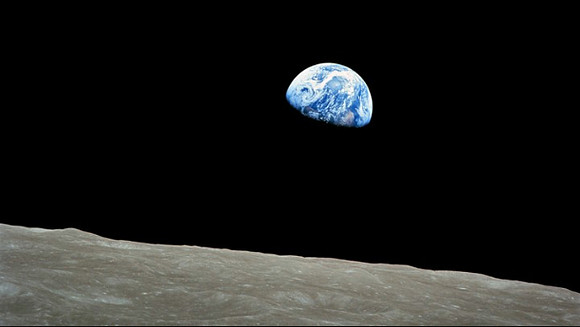
Earthrise
"Earthrise" Taken by Apollo 8 Crew, Christmas Eve, 1968 Fifty years ago we got our first view of this planet from outer space as seen by the crew of Apollo 8. The poet Archibald MacLeish was moved to write, "To see the earth as it truly is, small and blue and beautiful in that eternal silence where it floats, is to see ourselves as riders on the earth together, brothers on that bright loveliness in the eternal cold -- brothers who know now they are truly brothers."
All the World Is Birthday Cake
It's all too much for me to take The love that's shining all around here All the world is birthday cake So take a piece but not too much The idea of a hierarchy of the senses has been floating around since Aristotle, with sight claiming pride of place, followed in order by hearing, smell, taste and touch. It is unclear, however, how you determine which sense should top the charts, much less whether a hierarchy even exists. If you consulted a photographer, a musician, a perfumer, a cook and a pickpocket, I suspect all would give you different answers, based on their own proclivities. There’s no mystery why photographers would value seeing above the other senses. Seeing is also associated with reason, which may explain why it appeals to philosophers like Aristotle. But in truth, all the senses are subordinate to the mind and will flee into the shadows at the first sign of a thought. We may apprehend reality through the senses, but in the end the world is whatever we think it is. “All the world is birthday cake,” sang George Harrison in the Beatles animated film, Yellow Submarine. The song came at the movie’s climax, amid a kind of psychedelic fireworks display meant to please all the acidheads who flocked to see the film on its debut in 1968. Harrison later acknowledged the song tried to capture what it is like to take LSD. As one of the acidheads who flocked to see Yellow Submarine a half century ago, I would say the experience is most succinctly captured in the song’s title and opening line, “It’s All Too Much.” There are few literary antecedents for the psychedelic experience. The English novelist Aldous Huxley wrote a book-length essay entitled The Doors of Perception (1954) chronicling an early experiment with the hallucinogenic drug mescaline. We assume taking hallucinogens is like putting your brain on steroids, but Huxley arrived at the opposite conclusion. He hypothesized that the brain normally functions as a “reducing valve” to filter out the otherwise overwhelming volume of sensory stimuli coming at us from very direction. Brain-imaging experiments have since confirmed that hallucinogens bypass the brain’s sensory-inhibiting mechanisms, enabling us to experience reality in all its unfiltered glory. Once freed from the mind’s straitjacket, the senses run riot, upending any hierarchy that might have existed. I picked up a camera long after I stopped dabbling in mind-bending drugs, so I can’t say what it would be like to try to take pictures while high on acid. I remember hearing a story long ago about a Zen master who took LSD and was asked how he found the experience. “It gave me a headache,” he said dismissively. Similarly, I expect LSD would do little to enhance my picture taking. By a mysterious process I do not fully understand, I find that merely looking through the viewfinder of a camera helps my visual cortex to overcome the brain’s sensory-inhibiting mechanisms. Perhaps it is just that I am paying close attention to what I am seeing. There is a reason why the brain comes equipped with sensory-inhibiting mechanisms. In evolutionary terms, you have to keep your on eye the ball, whether it is spotting prey or spotting predators. Clearly, you’ve got to eat – and avoid being eaten – in order to survive and propagate the species, which means you can’t be distracted by too much sensory stimulation. Aesthetics would appear to have no role to play, except perhaps in selecting a mate. And yet aesthetic appreciation is highly developed in our species, if not always highly compensated. Every culture has artisans or artists whose function is to call attention to the beauty in creation. Once you begin looking at the world through the viewfinder of a camera, you realize that beauty is not an incidental part of creation. It’s everywhere you look. I have exhibited photographs taken in my own home, in my yard, in the field behind my house and in my neighborhood. One of my long-term projects is to take pictures of everything within walking distance of my house, and I realize I will never run out of subject matter. Lately I have been photographing wildflowers found by the side of the road. I bring them home and shoot them against a dark backdrop with no illumination other than a single high-intensity LED light. All the world is birthday cake, as George Harrison said. But you can’t be too greedy. You’ve got to take it a piece at a time. 10th Annual Ten X Ten
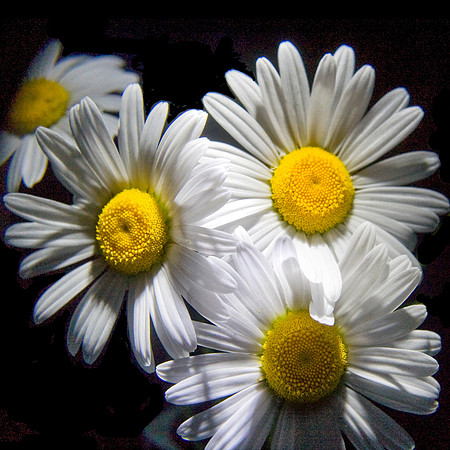
"Illuminated Daisy 2" by Eric Rennie This image has been accepted in the 10th Annual Ten X Ten juried competition at the Midwest Ceter for Photography in Wichita, KS My photograph is part of my illuminated flower series, mostly wildflowers picked by the side of the road and photographed indoors with a macro lens under a bright white cone of life. Each of the winning entries is 10" by 10' square. The exhibition runs from November 30, 2018 through December 31, 2018. This image and others in the show are available for order online from the gallery for $100 each. |