Aubade
"Greenhouses at Dawn" by Eric Rennie During a fraught period in my life many years ago, I got into the habit of listening to a classical music show on public radio called Morning Pro Musica during my 40-minute drive to work. The program provided welcome solace at a time when my job was all consuming. The program’s host, Robert J. Lurtsema, was once described as “the world’s gentlest alarm clock” for his practice of starting each broadcast with five minutes of birdsong. I normally didn’t catch the beginning of the show at 7:00 a.m. and didn’t know about the birds until I happened to leave for work earlier than usual one morning. At first I thought I might have tuned in to the wrong station. The birds kept singing for long minutes without interruption. In broadcast terms, this interlude seemed like an eternity. Was the station having technical difficulties? After a minute or two my anxious thoughts died away, and I began to listen. I realized it had been months since I had noticed birds singing or children’s laughter or any other musical note not on the radio. In those few minutes I felt reconnected to life. For the better part of an hour after sunrise each day, birds mostly have the airwaves to themselves – speaking here not of the radio but of the natural world. As much as one might wish to believe they are greeting the dawn with a song, the birds are merely going about their business, staking out territory and attracting mates with their distinctive calls. Of course, what ornithologists characterize as a mating call might also be fairly described as a love song. And who’s to say that the dawn has not put birds in the mood? Regardless, their voices carry farther when the air is cooler, and there is less wind in the early-morning hours. Songbirds also have less competition for airtime from buzzing insects and traffic noise. According to one theory, different species of birds (and other creatures) occupy different “acoustic niches” to minimize overlapping frequencies and to create a harmonious soundscape. As it happens, their “dawn chorus” coincides with what photographers refer to as the “golden hour” – not because of any musical accompaniment but because the quality of the light at that hour (and at dusk) is particularly conducive to outdoor photography. The sun is lower to the horizon, and its light travels farther in the atmosphere, emphasizing warmer tones on the color spectrum, reds and yellows, while blues are more diffused. The result is softer light and a golden glow that flatters everything it falls upon. Photographers are able to shoot directly into the sun, which at any other time of day would result in a blown-out image. If you are up with the birds, as I often am, to take pictures at first light, you can easily appreciate why the sun was once worshipped as a god. There is something primordial about the dawn. Even though the sun has risen well over one trillion times since the earth began turning, it always seems as if the world is beginning anew. It is always the first day of creation, and God has once again summoned forth light from darkness. The sun spills over the horizon, and everything the light falls upon seems newly formed, bathed in golden light. “Where were you when I laid the foundation of the earth?” God demanded of Job when he spoke to him out of the whirlwind. Job was nowhere to be found then, of course, and neither were we. But we can easily imagine being there when we are up with the birds to greet the dawn. We can imagine being there when, as God described it, “the morning stars sang together and all the heavenly beings shouted for joy."
The Blinds of Habit
"Alex Framed" by Eric Rennie We are what we repeatedly do,” Will Durant wrote, attributing the thought to Aristotle. A 19th-century physiologist named William Benjamin Carpenter noted that any sequence of mental action that has been frequently repeated tends to perpetuate itself. He wrote, “…we find ourselves automatically prompted to think, feel, or do what we have been before accustomed to think, feel, or do, under like circumstances, without any consciously formed purpose, or anticipation of results.” While advertisers might not see much potential in this, the pioneering psychologist William James recognized other advantages to habitual modes of behavior: The more of the details of our daily life we can hand over to the effortless custody of automatism, the more our higher powers of mind will be set free for their own proper work. There is no more miserable human being than one in whom nothing is habitual but indecision, and for whom the lighting of every cigar, the drinking of every cup, the time of rising and going to bed every day, and the beginning of every bit of work, are subjects of express volitional deliberation. Neuroscientists have since determined that habits are formed in a region of the brain called the basal ganglia, which is located behind the prefrontal cortex where our conscious decision-making occurs. Unlike cognitive learning, which takes place quickly, habits are acquired slowly and are difficult to break, as any reformed smoker will gladly tell you. The two regions may work together when we are learning a new skill, but once it becomes routine, the basal ganglia takes over and the cerebral cortex can turn its attention elsewhere. This enables us to tie our shoes, brush our teeth, drive a car and do a thousand and one other things without having to laboriously think our way through each step of the process. And so, while we may be nothing more than a walking bundle of habits as time goes on, there is no need to be weighed down by dull routine. Presumably there is some evolutionary advantage to being able to walk and chew gum at the same time – or as William James put it, to set free our higher powers of mind for their own proper work. For example, I composed the first sentence of this paragraph this morning while shaving, and the rest followed as I was taking a shower. I was even able to do a bit of rewriting while opening the curtains downstairs and unloading the dishwasher before breakfast. The poet Wallace Stevens used to write verses in his head while walking three miles to work at his day job at an insurance company in Hartford. In theory, at least, his ability to walk and write poems at the same time aided his chances of surviving to pass his poetry-writing genes on to future generations. Our talent for multi-tasking, as we now call it, is obviously helped if one or more of those tasks do not require us to pay attention to what we are doing. The question is whether we pay proper attention to any of them. William James no doubt exercised higher powers of mind while performing rote tasks. But the rest of us, I suspect, are otherwise engaged much of time in daydreaming or wondering what we are going to have for lunch. The Russian mystic George Gurdjieff complained that we are “animated automatons” who waste our lives in a hypnotic state of “waking sleep.” Much spiritual practice in both Eastern and Western traditions consists of techniques designed to help people wake up. Granted that we all have mental equipment that allows us to sleepwalk through our lives. But then we also come equipped with those higher powers of mind that enable us to pay attention to things besides tying our shoelaces or brushing our teeth. Not long after I retired at 55, I took up photography in a serious way. The equipment I use is expensive, and it took a long time to become reasonably proficient with it. All of the things that the human eye does naturally must be adjusted manually on a high-end camera so I can capture something that approximates what I am seeing. That requires much trial and error still. The hardest part is the seeing, without which no amount of technical proficiency will produce a decent picture. You develop technical proficiency by working the camera until you don’t have to think about what you are doing while shooting. But if you are capable only of habitual seeing, you might as well leave the lens cap on when you are taking the picture. Photography is all about putting a frame around your experience of the world to get people to see, which makes it a kind of spiritual discipline for me. There are plenty of fine photographers who take pictures of spectacular scenery for National Geographicor Sierra Club calendars. But what is there other than their technical proficiency and the scenery itself? I am more impressed by photographers who can take everyday reality and make you see it as if for the first time. If they can wake me up, then I know they are awake. Look, See
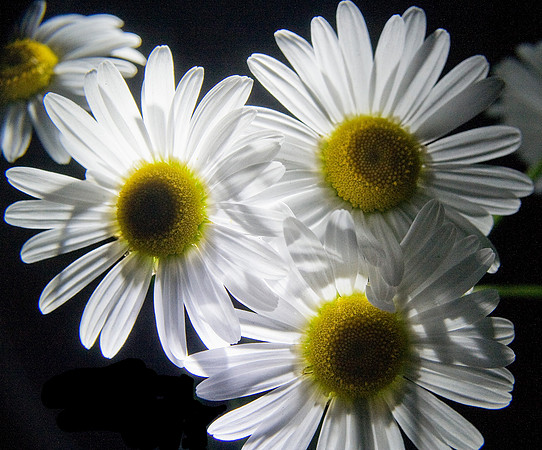
"Illuminated Daisy" by Eric Rennie “Wisdom does not inspect, but behold,” Thoreau wrote. “We must look a long time before we can see.” He was speaking of scientific observation, but he might as well have been writing about what artists and poets do. We are all looking for things, but how many of us really see? To begin with, seeing requires us to unlearn all those shortcuts that enable us to swiftly find what we are looking for without really noticing anything else. There are obvious evolutionary advantages to being able to quickly spot predators or prey without being distracted by the view. But this is not the same thing as seeing what you are not looking for, which is another name for discovery. Two years after his sojourn at Walden Pond, Thoreau embarked on a new daily regime that involved long walks around Concord to observe and record the natural world. In the evenings, his notes were carefully transferred to his journal, which by the time of his early death from tuberculosis at age 44 already amounted to some two million words. Thoreau was a younger contemporary of Charles Darwin and avidly read his works. Like Darwin he was always careful to ground his conclusions in a close observation of nature. He wrote, “The true man of science will know nature better by his finer organization; he will smell, taste, see, hear, feel, better than other men. His will be a deeper and finer experience. We do not learn by inference and deduction, and the application of mathematics to philosophy, but by direct intercourse and sympathy.” One must truly see in order to learn, but one must also learn to see, as Thoreau well knew. “For the newly sighted,” Annie Dillard wrote in Pilgrim at Tinker Creek, “vision is pure sensation unencumbered by meaning.” She was speaking of those who had gained their sight following advances in cataract surgery in the 19th century, but the same applies to newborns for whom the world is still a crazy-quilt of raw color and motion. They must learn the ins and outs of this world, quite literally: its heights and depths, foreground from background, object from surroundings. Eventually names are put to the things they see. For scientific observers, the process undergoes continual refinement as they learn the ins and outs of the world they see in a microscope or cloud chamber. “Direct perception of form requires being experienced in the relevant field of thought,” stated the Polish bacteriologist and philosopher Ludwik Fleck. “The ability directly to perceive meaning, form, and self‐contained unity is acquired only after much experience, perhaps with preliminary training.” Fleck added, “At the same time, of course, we lose the ability to see something that contradicts the form.” In effect, the process of learning to see blinds us to things that don’t conform to our habits of seeing. Thomas Kuhn used the word “paradigm” as a term of art to describe a particular way of seeing the world in his book The Structure of Scientific Revolutions. A paradigm is the conceptual framework around which scientific observations are organized, and observations that fall outside that framework are apt to be ignored. Scientists are supposed to base their theories on the careful observation of natural phenomena, but Kuhn noted they are as prone to fit facts to theory as anyone else. They tend to reexamine their theories only when the weight of accumulated anomalies forces them to do so. Photographers and other visual artists must also go against habits of seeing in order to do their work properly. To see the world afresh, they must forget everything they think they know about it. For the artist, learning to see is at once unlearning all they have seen, stripping away all the words and concepts, until nothing remains but pure sensation unencumbered by meaning. It is the world as a newborn might find it, all color, shape, texture, light and shadow. Realistically, one can sustain such a vision only momentarily. For a photographer, that is precisely the moment when you snap the picture. A Story to Tell
I do not normally think of my photographs as telling a story. But this one clearly does. What is a Christmas wreath doing affixed to a chain-link fence topped by barbed wire outside an abandoned industrial site? Fortunately, there was a message written in magic marker on the ground beneath it. It read: "Please do not remove until after the new year if possible. My dad passed away February 20th 2018. He was here 365 days a year with his dog. I have no other way to honor him for Xmas. His daughter." As it happens, the industrial site is across the road from a small park along the Connecticut River. My guess is the man came to the park 365 days a year. I wonder what has become of his dog. Wet
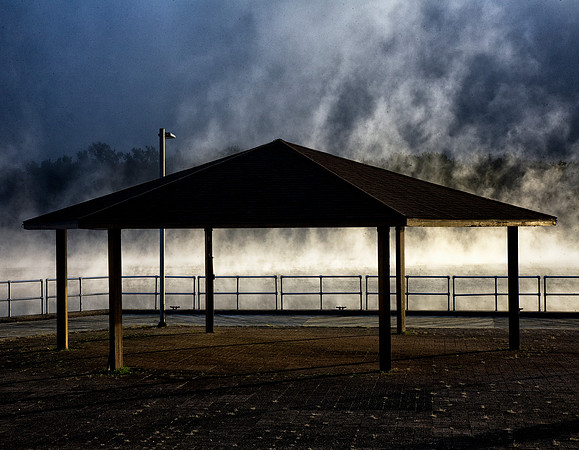
"Harbor Park in Fog 5" by Eric Rennie Sometimes it pays to go rummaging around in my old photo files. This image was taken several years ago as the fog was lifting at Harbor Park in Middletown, CT enroute to my morning workout at the Y. My photo has been accepted in a juried competition called Wet at the Darkroom Gallery in Essex Junction, VT. The exbition runs from February 7, 2019 until March 17, 2019. The juror is photographer Elizabeth Opalenik. |