His Own Small World
Image, right, from Michael Paul Smith's "Elgin Park" series, with setup shot at left People my age read obituaries to keep up with the departures of friends and acquaintances. Recently I came across an obituary for someone who was neither friend nor acquaintance; indeed, not someone I had previously heard about at all, a fellow photographer named Michael Paul Smith. Smith was a miniaturist, noted for his painstaking recreations of life in small-town America, based on his memories of growing up in mid-century Sewickley, Pennsylvania. Like many boys of that era, myself included,he had built model cars. As an adult, he collected pricey die-cast 1/24-scale model cars and trucks purchased from the Danbury Mint. His photographs started out as a way to show off his collection on the Internet, and they soon went viral. Always artistically inclined, Smith would build dioramas around his vehicles and then use a technique called forced perspective to blend them in with actual scenes of buildings, foliage and sky in the Massachusetts town where he lived as an adult. The results are so uncannily lifelike that Smith was sometimes accused of using Photoshop to create a fake reality. However, although he did sometimes use Photoshop color filters to mimic the look of old Kodachrome prints, the finished products were mainly the result of his own artistry and painstaking attention to detail. Smith regarded his works not merely as photographs but as stories. For example, an image of an old car with its hood up and a toolbox open beside it is titled “The Day It Happened – Corliss Dink’s ’37 Studebaker.” Another image shows a cherry-red 1960 T-Bird, its trunk and driver’s door flung open, being hauled out of a ditch by a pickup truck. Its title: “Teen Idol Slips into Town.” Perhaps most enigmatic of all, a picture of an old wooden caboose parked on a siding next to a couple of 30s-era coupes, with the title, “The Abandoned Caboose, a Pickle Recipe and Mrs. Menz.” According to the blub Smith appended to his photo, the widow Francine Menz, heir to the Horseradish estate, was putting up pickles in secrecy in the abandoned caboose. But whom was she making them for? We’ll never know, because “Francine fled the scene and was never heard from again.” Almost all of Smith’s photographic compositions prominently feature cars and trucks, and almost all take place in “Elgin Park,” modeled after the steel town outside Pittsburgh where he grew up. He frankly acknowledged that he was presenting a somewhat idealized vision of the past. Smith noted in a documentary about his work that there were "hints" of darker themes from his childhood but nothing more. "Elgin Park does not need the bad,” he said. Smith’s depictions of small-town life are so realistic that it may take a while to realize there are no people in any his pictures. Admittedly, it is easier to present true-to-life scale-model vehicles and buildings than scaled-down human beings. But Smith said the decision to leave out people was deliberate. “I want viewers to put themselves into the scenes,” he explained. “I’m creating a mood, something familiar in the viewer’s mind.” Without explicitly saying so, Smith had also created a world where he felt safe. Growing up in a steel town was an alienating experience for a boy with artistic aspirations who knew by kindergarten that he was gay. He suffered the fate common to those who are perceived as different and was bullied mercilessly in school. His teachers took pity on him and allowed him to leave school early each day so he wouldn’t be pummeled on the way home. As an adult, he struggled with depression and drug abuse, surviving multiple suicide attempts. He went from job to job without really landing on a career. Despite his extensive collection of vintage model cars, he didn’t actually drive a car of his own, nor did he own a cell phone or a TV set. He never really seemed at home in this world, so he created one of his own. And thanks to the Internet, his own small world has been shared with millions of people. Elgin Park is a classic example of a paracosm, a richly imagined world that exists apart from this one. In literature, there are such fantasy realms as Alice’s Wonderland, Hogwart’s Castle and Narnia, as well as worlds very much like our own, such as William Faulkner’s Yoknapatawpha County. Psychologists also use the term paracosm to describe the elaborate fantasy worlds dreamed up by precocious children, often in response to the death in the family or other childhood trauma. The fantasizing may persist for years, even into adulthood. “I had some relatives that were missing a father,” Smith recalled. And after eavesdropping, he found out why. “People were murdered; people were mutilated. Those were pretty tough stories. Some of the stories for Elgin Park were inspired by those.” Can Smith be regarded as a real artist or just a hobbyist who never outgrew his fascination with model cars? His studio was his kitchen table, and his camera was pretty rudimentary. He occupied a niche far from the artistic mainstream. And yet his compositions were exquisitely lit, and, notwithstanding his crappy camera, he demonstrated technical mastery that would be the envy of any artist. Most importantly, he showed absolute fidelity to his artistic vision until the very end. Smith died of pancreatic cancer and complications from diabetes. He was 67. The announcement on his Flickr page said simply, “We are sad to report that Michael Paul Smith moved permanently to Elgin Park (his words) this past Monday, November 19, 2018.”
God by the Numbers
"Illuminated Queen Anne's Lace 2" by Eric Rennie For those of us who never got past introductory calculus, the idea that “God is a mathematician of a very high order,” as the physicist Paul Dirac once expressed it, might appear to do little to clarify things. What does it mean when a mathematician or physicist calls an equation “beautiful,” if it looks to the rest of us like a Mayan hieroglyph? But then I discovered there is abundant photographic evidence of God’s mathematical handiwork in nature; in fact, I had taken a number of such pictures myself without realizing it. Lately I have been photographing wildflowers I find growing by the side of the road. I shoot them in a dark room under a cone of white light, using a macro lens that allows me to get in close. I suspect I will never appreciate the beauty of an equation in written form, but it is quite another matter when the equation is expressed as a fractal, a geometric configuration that abounds in nature, including the intricate spiral formations in the head of a daisy or the tiny iterative blooms in Queen Anne’s Lace. Once you know what you are looking for, fractals can by found anywhere: in crystals, snowflakes, pineapples, Romanesco broccoli, lightning bolts, tree branches, even coastlines – all of which can be expressed mathematically. Admittedly, there are gaps in my education, particularly when it comes to higher math. But I have an excuse this time: there wasn't even a name for fractals until I was out of school. They were discovered – if that is the word -- by Benoit Mandelbrot, a French mathematician who spent most of·his career at IBM, because no university worthy of his talents would hire him. (Late in his career he landed at Yale, which awarded him tenure at age 75.) According to Mandelbrot, fractals are natural or man-made objects that are “irregular, rough, porous or fragmented and which possess these properties at any scale. That is to say they have the same shape, whether seen from close or from far.” To me, their significance is not just that they can be described mathematically, but that many of them are quite beautiful. If God is a mathematician, then he is also an artist.
A Gift to Be Simple
Einstein's genius is sometimes attributed to his knack for seeing the world like a child and posing questions that only a child would think to ask. What would I see in the mirror if I were traveling as fast as light? Why do I feel weightless when I fall? And so forth. There was another side to Einstein, of course -- the practical side that landed him a job in the Swiss patent office when no academic institution would hire him. He was able to translate his child-like musings into the rigorous language of mathematics and thereby dismantle Newton's "clockwork" universe of absolute time and space. Like a child taking apart a clock, Einstein was never quite able to put the universe back together again. His work in formulating relativity theory and in laying the foundations of quantum mechanics was all accomplished in the first 20 years of his career. He spent the next 30 years in a fruitless quest for a unified field theory that would account for all the known physical forces in the universe. Many of his colleagues thought Einstein had gone down a blind alley in refusing to come to terms with the probabilistic world of quantum mechanics, which governs subatomic particles. "God does not play dice," he grumbled. What he found most troubling was that the behavior of subatomic particles could only be understood in relation to an observer. He had no qualms about jettisoning absolute time and space, but he was not prepared to dispense with objective reality, i.e., a world that exists independently of an observer. It would never occur to a child to remove himself from the world he finds himself in. A small child playing hide-and-seek will often cover his eyes and assume no one can see him. He has not yet learned to imagine the world through the eyes of another person so he can hide himself from their view. Playing hide-and-seek is one of countless ways we learn to see the world as others do; in time, we come to adopt a whole world view. This process is essential to our ability to live with others in the world, but perhaps inevitably we stop seeing things for ourselves. We no longer ask the naive questions that enabled Einstein to see out of the box Newton had put us in. So now how do we see outside Einstein's box? "It took me four years to paint like Raphael," Picasso once said, "but a lifetime to paint like a child." Substitute "see" for "paint," because that's what Picasso is really talking about here. It can take a lifetime to see once again as a child, to see as we actually see and not see as we think. The philosopher Douglas Harding was hiking in the Himalayas as a young man when all of a sudden he stopped thinking and started seeing things as they actually appeared to him. His most startling discovery was that he had no head. He could see arms and legs and a torso, but they didn't appear to be attached to anything. In the place of honor normally occupied by what he thought of as his head, there was a vast empty space filled with earth and sky and snow-capped mountain peaks. "I had lost a head and gained a world," he wrote in "On Having No Head." We imagine we are contained in an immense three-dimensional space called the world, but that it not the way we experience it. What we actually see is that the world, if anything, is contained within us. We believe we pass through time, but time as we actually experience it passes through us. This may sound like the height of narcissism, but it's really the opposite. A narcissist experiences the world as a backdrop for the high drama of self, whereas the realist sees that one's true self is nothing other than the world. Field Work: Landscape and Architecture
"Nooks Hill Road at First Light" by Eric Rennie Someone once said you should measure your productivity as an artist by how many rejections you receive rather than by your successes. Sometimes that is what keeps me going as I send off work for juried competitions around the country. I've certainly had my share of rejections. But you learn to persist. In some cases, I have grown attached to one or another of my photographs and keep submitting them in the face of repeated rejections, hoping that some juror somewhere will recognize its artistic merit. Such was the case with the image above, which has been accepted in a juried competition called "Field Work: Architecture and Landscape" at the Black Box Gallery in Portland, OR. The exhibition, curated by gallery owner Todd Johnson, runs from July 1, 2019 to July 20, 2019. Nor'Easter
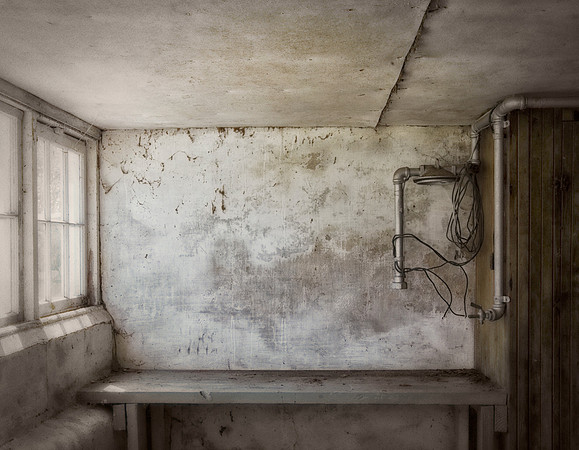
"Milking Room" by Eric Rennie The photograph above appears in "Nor'Easter: The 49th Annual Juried Exhibition" at the New Britain Museam of American Art in New Britain, CT, running from June 22, 2019 to July 13, 2019. The image is part of a series I took at a small dairy farm in Blackstone, Massachusetts that had been in my family for more than a century. The farm was sold a few years ago after my 103-year-old aunt could no longer live there on her own. This image and three earlier photographs from this project were exhibited at the Gertrude Herbert Institute of Art in Savannah, GA. |