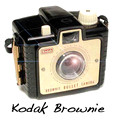
Kodak Brownie
Not long ago my son Matthew e-mailed photos he had taken with his latest smart phone while hiking with my wife on Sleeping Giant Mountain, not far from our home in Connecticut. I was struck by the technical excellence of the images, a far cry from the pictures you could take on my old Kodak Brownie, arguably the world’s first point-and-shoot camera. By the time my parents gave me one back in the 1950s, the Brownie had already been around for more than half a century. Apart from some modest technical improvements along the way, the Brownie was still essentially a simple box camera, with a rudimentary lens, viewfinder and shutter, along with a dial to advance the film in the camera. Easy to use, the Brownie was primarily marketed to kids; hence the name, which was taken from popular children’s book characters at the turn of the last century. Millions of those cameras were sold, but Kodak made its real money selling film, so the company did everything it could to encourage its customers to take lots and lots of pictures. The principal drawback to the Brownie, I quickly discovered, is that you had to send away to get your film processed and then wait days or weeks for your prints to be developed. Being a kid, I found this deferred gratification hard to take. And more often than not, the results were disappointing when the prints did show up, at least mine were. The camera soon found its way to the back of my closet and stayed there. Later I learned that Ansel Adams got his start taking pictures with a Brownie, which he presumably did not stash away in a closet. Polaroid solved the deferred gratification problem with an instant camera that developed its own prints right on the spot. However, the results weren’t much better than what you could get with a Brownie, and each print was one of a kind, so you couldn’t make copies for your family and friends. Recently someone asked me whether I had an old Polaroid she could borrow. I had to tell her I never owned a Polaroid camera, and if anyone still had one it was probably stashed away in the back of a closet somewhere. Film cameras of any kind have all but disappeared; indeed, cameras as such are limited to the die-hard few like me who still insist on fussing with lenses and dials before snapping a picture. Little did I imagine when I was growing up back in the 1950s that most people would one day be taking pictures with a telephone they carried around in their pockets. Or that their photos would be instantly available for transmission to the entire world via social media. Kodak’s long-ago dream of getting the masses to take lots and lots of pictures has been realized, but not with film cameras. Kodak sold off the last of its camera film business in 2013. |
Archive
January
February
March
April
May
June
July
August
September
October
November
December
|