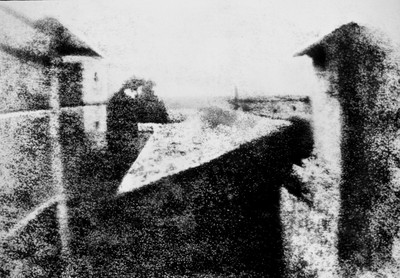
A Photograph Is Once, Forever
Facebook estimated in 2013 that its users were uploading 350 million photographs per day onto its servers, which works out to nearly a quarter of a million per minute. Altogether, we will soon reach the point where one trillion photographs are taken every year, most of which will wind up on the Internet. Long before social media and digital cameras, cultural critic Susan Sontag observed that we consume images at an ever faster rate. This is only partly due to technological innovations that make it easier to produce them. The human eye naturally seeks movement, and there may be an evolutionary advantage to our craving for novelty. Advertisers know they must provide more and more visual stimulation to keep us watching. Attention spans shrivel under the onslaught of imagery, which just feeds our appetite for still more. Now everybody is so busy taking pictures, we have forgotten how to see. We have become like the glutton at a feast who wolfs down his food without bothering to taste it. What will it take to get us to savor what we see? John Donne may have given us a clue. More than four centuries back he wrote, "There is nothing that God hath established in a constant course of nature, and which therefore is done every day, but would seem a miracle, and exercise our admiration, if it were done but once." Suppose instead of billions of photographs, there were only one? There was a time, of course, when there was only one. In 1826, a French inventor named Nicéphore Niépce used a primitive camera to capture the view from his window onto a polished pewter plate coated with bitumen (image above). Niépce’s invention, which he called the heliograph, failed to have much of an impact, but his business partner, Louis Daguerre, created a sensation a few years later with another photographic process named after himself, the daguerreotype. One commentator rhapsodized, “All nature shall paint herself — fields, rivers, trees, houses, plains, mountains, cities, shall all paint themselves at a bidding, and at a few moment’s notice.” To another critic, the wondrous alchemy that caused a fixed image to appear on a metal plate or piece of paper was “divine perfection” – exactly the sort of miracle John Donne was talking about when natural processes are seen as if for the first time. As a fine arts photographer, I am certainly aware that I am pursuing a specialty craft in a commodity market. Anybody with a smart phone these days can take pictures that are technically quite good. Yet I stubbornly hope for a miracle -- that out of the billions of images out there I will produce one that can stand as if it were the only one. Every artist worth his or her salt does the same. The impulse is not as grandiose as it may sound – quite the opposite in fact. We are merely responding the best we know how to what we are privileged to see. In the end, it is not so much the image that is unique but the things God has established in the constant course of nature. Once you have learned to see them as they truly are, you realize that everywhere you look there is some miracle waiting to be captured on the fly. As the photojournalist Henri Cartier-Bresson put it, “Life is once, forever.” So is a good photograph. |
Archive
January
February
March
April
May
June
July
August
September
October
November
December
|